Wednesday, September 15, 2021

For more than 100 years, the U.S. Supreme Court has held states have the "police power" to require vaccinations; so why is COVID-19 raging again?


Why have state and local governments allowed a summer surge of COVID-19 to happen when they have safe and effective vaccines at their disposal -- and the legal authority to enforce their use? That question arises from a Washington Post article under the headline: "Require the vaccine: It's time to stop coddling the reckless." Writes Ruth Marcus:

It’s reasonable, it’s fair, and it’s legal to step up the pressure on the reckless noncompliant. By reckless, I mean to exclude some people: If you have a medical condition that counsels against vaccination, you are excused.

If you have a good-faith religious objection, same — although I have a hard time imagining what that might be beyond adherents of Christian Science, or what religion does not advocate some version of the Golden Rule. Yes, some fetal cell lines were used in the development or testing of the vaccines, but the Vatican has declared that it is “morally acceptable” to take the vaccines, and that reasoning seems solid.

Federal judges have already rejected challenges to vaccine mandates by hospitals and public universities. The Equal Employment Opportunity Commission has made it clear that federal anti-discrimination laws don’t prevent private employers from requiring proof of vaccination. The Justice Department’s Office of Legal Counsel concluded that federal law “does not prohibit public or private entities from imposing vaccination requirements” for vaccines even at the emergency-use stage.

A century ago, balancing the tension between individual liberties and public safety, the Supreme Court upheld the ability of state and local governments to enforce mandatory vaccination laws. “In every well-ordered society charged with the duty of conserving the safety of its members,” wrote Justice John Marshall Harlan, “the rights of the individual … may at times, under the pressure of great dangers, be subjected to such restraint, to be enforced by reasonable regulations, as the safety of the general public may demand.”

Then the great danger was a smallpox epidemic. Today it is a global covid-19 pandemic. The “safety of the general public” demands a “reasonable” response today, just as it did in 1905.

The SCOTUS case in question was styled Jacobson v. Massachusetts, 197 U.S. 11 (1905). In it, a Massachusetts resident named Henning Jacobson challenged as unconstitutional a state law that made smallpox vaccinations mandatory. Jacobson claimed that, back in his native Sweden, he had suffered a bad reaction to a vaccine as an infant, struggling for years with an angry rash.

Roughly 115 years after it was issued, the Jacobson case is back in the news because of President Joe Biden's vaccine mandates last week related to the COVID-19 pandemic. The nation's highest court rejected Jacobson's argument that he was protected by the U.S. Constitution's Due Process Clause, finding the state's police power gave it the authority to enforce such a statute. That likely means Biden's COVID orders rest on solid legal footing. From the opinion (Most citations omitted for ease of reading):

The authority of the State to enact this statute is to be referred to what is commonly called the police power — a power which the State did not surrender when becoming a member of the Union under the Constitution. Although this court has refrained from any attempt to define the limits of that power, yet it has distinctly recognized the authority of a State to enact quarantine laws and "health laws of every description;" indeed, all laws that relate to matters completely within its territory and which do not by their necessary operation affect the people of other States. According to settled principles the police power of a State must be held to embrace, at least, such reasonable regulations established directly by legislative enactment as will protect the public health and the public safety. It is equally true that the State may invest local bodies called into existence for purposes of local administration with authority in some appropriate way to safeguard the public health and the public safety. The mode or manner in which those results are to be accomplished is within the discretion of the State, subject, of course, so far as Federal power is concerned, only to the condition that no rule prescribed by a State, nor any regulation adopted by a local governmental agency acting under the sanction of state legislation, shall contravene the Constitution of the United States or infringe any right granted or secured by that instrument. A local enactment or regulation, even if based on the acknowledged police powers of a State, must always yield in case of conflict with the exercise by the General Government of any power it possesses under the Constitution, or with any right which that instrument gives or secures.

Were any of Jacobson's constitutional rights trampled by the state law? No was the answer from the high court:

We come, then, to inquire whether any right given, or secured by the Constitution, is invaded by the statute as interpreted by the state court. The defendant insists that his liberty is invaded when the State subjects him to fine or imprisonment for neglecting or refusing to submit to vaccination; that a compulsory vaccination law is unreasonable, arbitrary and oppressive, and, therefore, hostile to the inherent right of every freeman to care for his own body and health in such way as to him seems best; and that the execution of such a law against one who objects to vaccination, no matter for what reason, is nothing short of an assault upon his person. But the liberty secured by the Constitution of the United States to every person within its jurisdiction does not import an absolute right in each person to be, at all times and in all circumstances, wholly freed from restraint. There are manifold restraints to which every person is necessarily subject for the common good. On any other basis organized society could not exist with safety to its members. Society based on the rule that each one is a law unto himself would soon be confronted with disorder and anarchy. Real liberty for all could not exist under the operation of a principle which recognizes the right of each individual person to use his own, whether in respect of his person or his property, regardless of the injury that may be done to others. This court has more than once recognized it as a fundamental principle that "persons and property are subjected to all kinds of restraints and burdens, in order to secure the general comfort, health, and prosperity of the State; of the perfect right of the legislature to do which no question ever was, or upon acknowledged general principles ever can be made, so far as natural persons are concerned." Railroad Co. v. Husen, 95 U.S. 465, 471,  we said: "The possession and enjoyment of all rights are subject to such reasonable conditions as may be deemed by the governing authority of the country essential to the safety, health, peace, good order and morals of the community. Even liberty itself, the greatest of all rights, is not unrestricted license to act according to one's own will. It is only freedom from restraint under conditions essential to the equal enjoyment of the same right by others. It is then liberty regulated by law." In the constitution of Massachusetts adopted in 1780 it was laid down as a fundamental principle of the social compact that the whole people covenants with each citizen, and each citizen with the whole people, that all shall be governed by certain laws for "the common good," and that government is instituted "for the common good, for the protection, safety, prosperity and happiness of the people, and not for the profit, honor or private interests of any one man, family or class of men." The good and welfare of the Commonwealth, of which the legislature is primarily the judge, is the basis on which the police power rests in Massachusetts.

Was the state law onerous? Again, SCOTUS' answer was no:

Applying these principles to the present case, it is to be observed that the legislature of Massachusetts required the inhabitants of a city or town to be vaccinated only when, in the opinion of the Board of Health, that was necessary for the public health or the public safety. The authority to determine for all what ought to be done in such an emergency must have been lodged somewhere or in some body; and surely it was appropriate for the legislature to refer that question, in the first instance, to a Board of Health, composed of persons residing in the locality affected and appointed, presumably, because of their fitness to determine such questions. To invest such a body with authority over such matters was not an unusual nor an unreasonable or arbitrary requirement. Upon the principle of self-defense, of paramount necessity, a community has the right to protect itself against an epidemic of disease which threatens the safety of its members. It is to be observed that when the regulation in question was adopted, smallpox, according to the recitals in the regulation adopted by the Board of Health, was prevalent to some extent in the city of Cambridge and the disease was increasing. If such was the situation — and nothing is asserted or appears in the record to the contrary — if we are to attach any value whatever to the knowledge which, it is safe to affirm, is common to all civilized peoples touching smallpox and the methods most usually employed to eradicate that disease, it cannot be adjudged that the present regulation of the Board of Health was not necessary in order to protect the public health and secure the public safety. Smallpox being prevalent and increasing at Cambridge, the court would usurp the functions of another branch of government if it adjudged, as matter of law, that the mode adopted under the sanction of the State, to protect the people at large, was arbitrary and not justified by the necessities of the case. We say necessities of the case, because it might be that an acknowledged power of a local community to protect itself against an epidemic threatening the safety of all, might be exercised in particular circumstances and in reference to particular persons in such an arbitrary, unreasonable manner, or might go so far beyond what was reasonably required for the safety of the public, as to authorize or compel the courts to interfere for the protection of such persons. Wisconsin &c. R.R. Co. v. Jacobson, 179 U.S. 287, 301; Freund's Police Power, § 63 et seq. In Railroad Company v. Husen, 95 U.S. 465, 471-473, this court recognized the right of a State to pass sanitary laws, laws for the protection of life, liberty, health or property within its limits, laws to prevent persons and animals suffering under contagious or infectious diseases, or convicts, from coming within its borders. But as the laws there involved went beyond the necessity of the case and under the guise of exerting a police power invaded the domain of Federal authority and violated rights secured by the Constitution, this court deemed it to be its duty to hold such laws invalid. If the mode adopted by the Commonwealth of Massachusetts for the protection of its local communities against smallpox proved to be distressing, inconvenient or objectionable to some — if nothing more could be reasonably affirmed of the statute in question — the answer is that it was the duty of the constituted authorities primarily to keep in view the welfare, comfort and safety of the many, and not permit the interests of the many to be subordinated to the wishes or convenience of the few. There is, of course, a sphere within which the individual may assert the supremacy of his own will and rightfully dispute the authority of any human government, especially of any free government existing under a written constitution, to interfere with the exercise of that will. But it is equally true that in every well-ordered society charged with the duty of conserving the safety of its members the rights of the individual in respect of his liberty may at times, under the pressure of great dangers, be subjected to such restraint, to be enforced by reasonable regulations, as the safety of the general public may demand. An American citizen, arriving at an American port on a vessel in which, during the voyage, there had been cases of yellow fever or Asiatic cholera, although apparently free from disease himself, may yet, in some circumstances, be held in quarantine against his will on board of such vessel or in a quarantine station, until it be ascertained by inspection, conducted with due diligence, that the danger of the spread of the disease among the community at large has disappeared. The liberty secured by the Fourteenth Amendment, this court has said, consists, in part, in the right of a person "to live and work where he will," Allgeyer v. Louisiana, 165 U.S. 578; and yet he may be compelled, by force if need be, against his will and without regard to his personal wishes or his pecuniary interests, or even his religious or political convictions, to take his place in the ranks of the army of his country and risk the chance of being shot down in its defense. It is not, therefore, true that the power of the public to guard itself against imminent danger depends in every case involving the control of one's body upon his willingness to submit to reasonable regulations established by the constituted authorities, under the sanction of the State, for the purpose of protecting the public collectively against such danger.

In essence, SCOTUS found that Massachusetts had the authority to protect public health:

Looking at the propositions embodied in the defendant's rejected offers of proof it is clear that they are more formidable by their number than by their inherent value. Those offers in the main seem to have had no purpose except to state the general theory of those of the medical profession who attach little or no value to vaccination as a means of preventing the spread of smallpox or who think that vaccination causes other diseases of the body. What everybody knows the court must know, and therefore the state court judicially knew, as this court knows, that an opposite theory accords with the common belief and is maintained by high medical authority. We must assume that when the statute in question was passed, the legislature of Massachusetts was not unaware of these opposing theories, and was compelled, of necessity, to choose between them. It was not compelled to commit a matter involving the public health and safety to the final decision of a court or jury. It is no part of the function of a court or a jury to determine which one of two modes was likely to be the most effective for the protection of the public against disease. That was for the legislative department to determine in the light of all the information it had or could obtain. It could not properly abdicate its function to guard the public health and safety. The state legislature proceeded upon the theory which recognized vaccination as at least an effective if not the best known way in which to meet and suppress the evils of a smallpox epidemic that imperiled an entire population. Upon what sound principles as to the relations existing between the different departments of government can the court review this action of the legislature? If there is any such power in the judiciary to review legislative action in respect of a matter affecting the general welfare, it can only be when that which the legislature has done comes within the rule that if a statute purporting to have been enacted to protect the public health, the public morals or the public safety, has no real or substantial relation to those objects, or is, beyond all question, a plain, palpable invasion of rights secured by the fundamental law, it is the duty of the courts to so adjudge, and thereby give effect to the Constitution." Mugler v. Kansas, 123 U.S. 623, 661.

Whatever may be thought of the expediency of this statute, it cannot be affirmed to be, beyond question, in palpable conflict with the Constitution. Nor, in view of the methods employed to stamp out the disease of smallpox, can anyone confidently assert that the means prescribed by the State to that end has no real or substantial relation to the protection of the public health and the public safety. Such an assertion would not be consistent with the experience of this and other countries whose authorities have dealt with the disease of smallpox. And the principle of vaccination as a means to prevent the spread of smallpox has been enforced in many States by statutes making the vaccination of children a condition of their right to enter or remain in public schools. Blue v. Beach, 155 Indiana, 121.

Speaking of kids and school, I can remember my mother taking me to the lunchroom at Portland Elementary School in Springfield, MO, to have some kind of shot administered to my arm -- I don't think I even knew what it was for at the time. But I know now it was for smallpox, and even though I don't recall my mom saying it then, I would not have been allowed to attend school without it. It was not controversial in the least, best I could tell; we just did it, no fuss, no muss. Like millions of other Americans, I still have a slight bump on my upper left arm as a reminder of that day: 

The latest case upon the subject of which we are aware is Viemeister v. White, President &c., decided very recently by the Court of Appeals of New York, and the opinion in which has not yet appeared in the regular reports. That case involved the validity of a statute excluding from the public schools all children who had not been vaccinated. One contention was that the statute and the regulation adopted in exercise of its provisions was inconsistent with the rights, privileges and liberties of the citizen. The contention was overruled, the court saying, among other things: "Smallpox is known of all to be a dangerous and contagious disease. If vaccination strongly tends to prevent the transmission or spread of this disease, it logically follows that children may be refused admission to the public schools until they have been vaccinated. The appellant claims that vaccination does not tend to prevent smallpox, but tends to bring about other diseases, and that it does much harm, with no good.

"It must be conceded that some laymen, both learned and unlearned, and some physicians of great skill and repute, do not believe that vaccination is a preventive of smallpox. The common belief, however, is that it has a decided tendency to prevent the spread of this fearful disease and to render it less dangerous to those who contract it. While not accepted by all, it is accepted by the mass of the people, as well as by most members of the medical profession. It has been general in our State and in most civilized nations for generations. It is generally accepted in theory and generally applied in practice, both by the voluntary action of the people and in obedience to the command of law. Nearly every State of the Union has statutes to encourage, or directly or indirectly to require, vaccination, and this is true of most nations of Europe. . . .

"A common belief, like common knowledge, does not require evidence to establish its existence, but may be acted upon without proof by the legislature and the courts. . . .

"The fact that the belief is not universal is not controlling, for there is scarcely any belief that is accepted by everyone. The possibility that the belief may be wrong, and that science may yet show it to be wrong, is not conclusive; for the legislature has the right to pass laws which, according to the common belief of the people, are adapted to prevent the spread of contagious diseases. In a free country, where the government is by the people, through their chosen representatives, practical legislation admits of no other standard of action; for what the people believe is for the common welfare must be accepted as tending to promote the common welfare, whether it does in fact of not. Any other basis would conflict with the spirit of the Constitution, and would sanction measures opposed to a republican form of government. While we do not decide and cannot decide that vaccination is a preventive of smallpox, we take judicial notice of the fact that this is the common belief of the people of the State, and with this fact as a foundation we hold that the statute in question is a health law, enacted in a reasonable and proper exercise of the police power."

Could Biden's orders be challenged in court? Could that bring Jacobson back into the news as the guiding precedent on matters of vaccines? The answer to both questions is yes. But as we reported in a recent post, legal experts seem to think Biden's orders stand on firm legal ground:

In 1905, the Supreme Court ruled 7-2 in Jacobson v. Massachusetts that public health measures, like vaccination, imposed by states are constitutional because, in essence, living in society comes with restrictions, including those pertaining to public health.

At the heart of the case is the intersection between public health and a person’s individual rights. The court ruled that while the state doesn’t have absolute power to limit individual rights, it can impose reasonable limits when it comes to public health.

Now in the wake of the sweeping federal vaccine mandates President Biden announced on Thursday and claims by some Republican lawmakers that the rules are unconstitutional, experts say legal challenges to the measure are likely to be unsuccessful because of the strong precedent established by the Jacobson case.

“I think the Biden administration can clearly point to the fact that there is an ability of governmental entities to mandate vaccination,” Brian Dean Abramson, an adjunct professor of vaccination law at Florida International University, said of the Jacobson case.

Tuesday, September 14, 2021

From 9/11/2001 to 1/6/2021, Americans have been hit with so many steaming piles of lies that our collective sense of reality has grown dangerously out of whack

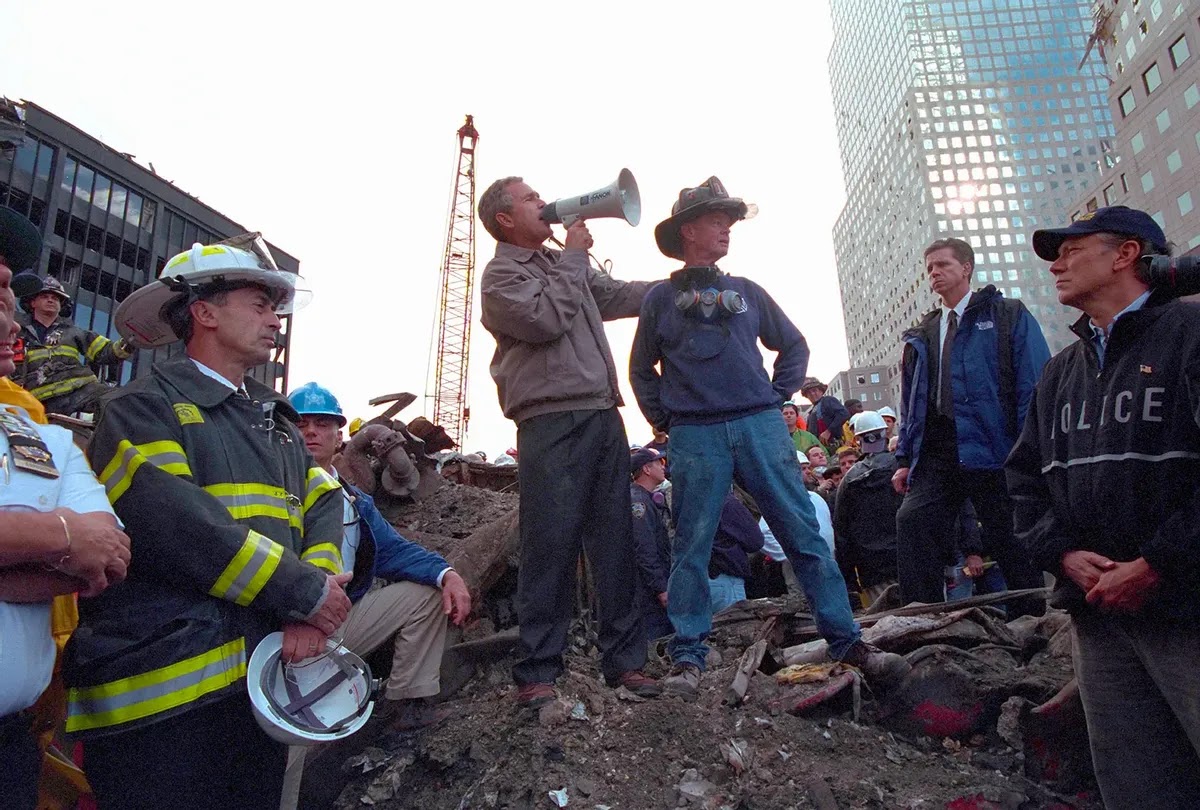
George W. Bush at the site of the World Trade Center

Many Americans took time out over the weekend to observe the 20th anniversary of the 9/11 attacks on our country. The events of 9/11 are sobering enough but at least one commentator made an especially stark observation: that 9/11 helped set the stage for the 1/6/21 attack on the U.S. Capitol. From that idea grows this troubling question: Did the tragedy of 9/11 teach Americans anything? Lucian K. Truscott,  a columnist at Salon, has doubts. Under the headline"9/11 and the birth of the Big Lie: Those attacks, and how we reacted to them, tore us apart as a nation — by destroying our shared sense of reality," Truscott writes:

What drove this country crazy after the attacks on the World Trade Center and the Pentagon on 9/11? Was it how vulnerable we had been shown to be, that a group of 19 men armed with nothing more than box-cutters could bring the entire country to a halt? Was it that the attack was aimed primarily against innocent civilians, with nearly 3,000 killed at the Twin Towers alone? Was it that with the 19 hijackers dead in the suicidal attacks, we didn't seem to have anyone to retaliate against?  Was it that we had no grasp whatsoever on understanding why our country, the freest and most democratic ever, was hated so much that they would attack us?

I remember how disconnected things felt for days, even weeks, after the attacks. Travelers outside the country didn't have a way to get home because flights had been canceled. People stranded in cities they were visiting within the country couldn't find cars to rent, there were so many trying to get home. Everyone seemed to feel a need to gather with families and friends and hunker down, as if another attack could come at any moment.

The country's leadership was frozen, stunned. Remember the photos of George W. Bush as an aide leaned over his shoulder and whispered the news into his ear? He was the president of the United States, and he looked scared to death. In fact, he was rushed from the school he was visiting in Florida to Air Force One, and his plane took off on what amounted to a flight to nowhere as his administration tried to pull itself together and decide how they would respond. It wasn't until hours later that Air Force One landed at Barksdale Air Force Base in Louisiana and Bush hurriedly addressed the press in a windowless conference room, vowing to "hunt down and punish those responsible for these cowardly acts." Three days would pass before the president was flown to New York to appear atop the rubble of the World Trade Center at what became known as Ground Zero to take a bullhorn and make the pledge that would launch the country on a trajectory that has yet to change: "I can hear you!" he shouted to the workers at the site, "The rest of the world hears you! And the people — and the people who knocked these buildings down will hear all of us soon!"

Those sounded like encouraging words at the time, but they proved to be not so soothing:

A collective madness ensued. A great scrambling began to protect us against … well, against what? Box-cutters first and foremost, it seemed, as a new regime of inspections began at airports everywhere. The initial panic over the hijacked flights would lead to the establishment of the Transportation Security Administration and the Department of Homeland Security, a kind of domestic department of defense which proceeded to put us on what amounted to a wartime footing within our own country that persists even today. How many times have you had to throw a set of fingernail clippers into a bin at airport security because a TSA agent was defending us from terrorism? How about removing your shoes because a lone lunatic made an unsuccessful attempt to blow up an airplane with a "shoe bomb"?

The entire paranoid regimen under which we still live 20 years later grew out of a supposed "war on terror" begun after 9/11 that has never ended. It took a decade to find and kill the actual terrorist who ordered the attacks on 9/11, but in the meantime two shooting wars were launched, only one of which had even the slightest connection to the terrorists who attacked us. There was an elemental problem: The war on terror wasn't against an enemy, it was against an idea, and ideas don't die when you hit them with bombs and bullets.

And so, without a readily definable enemy who could be seen and shot and killed and defeated, which is what wars are usually for, lies were substituted. We were buried with lies, and not just any lies. They had to justify the movement of hundreds of thousands of troops and the expenditure of trillions of dollars in treasure and the loss of thousands more American lives than died on 9/11 and countless more lives — enemies, civilians and, my goodness gracious, even a few real flesh and blood terrorists.

With one lie heaped on top of another, many Americans seemed to lose their sense of reality:

Sept. 11, 2001, was when the Big Lie was born. Or should we say, Big Lies, because they came fast and furious. By now they are known to be so completely without any basis in reality, so wholly bogus, that they hardly bear recounting. Weapons of mass destruction? Connections between Iraq and its government and leaders and the terrorists who attacked us on 9/11? Ha! 

And then came new Big Lies to support the earlier Big Lies: that we were "winning" the war on terror. How many times were we reassured that all those lives and all those dollars were not being pissed away for nothing? How many times were we reassured that we were rebuilding the countries that hadn't needed rebuilding until we attacked them? How many times were we told of the miraculous training of the Iraqi and Afghan armies? They even invented a new word that I never learned in the classes I took in military history at West Point, a word to describe the magic bullet that was going to win both wars: the surge. If only we sent 10,000 or 20,000 or 30,000 or 50,000 more troops, we could  win the mythical war on terror.

"Shock and awe" was a lie. "Taking Baghdad was a lie. The army of Iraq just went away. The "surge," each and every one of them, was a lie. "Winning" was a lie, every single time the word was used. Every. Single. Time. The Afghan army was a lie. It didn't even bother surrendering to the Taliban. It just went … poof. The Afghan "government" was a lie. It too went poof. The Iraqi government is a lie. Everything we have done to win the war on terror for two decades, 20 long years, has been a lie. We wasted trillions of dollars that could have been spent to, I don't know, feed hungry children in Arkansas? Pay for health care for poor families? Send kids to college? Reduce our dependence on fossil fuels and save our planet? 

We wasted all those lives, American and Afghan and Iraqi and German and Australian and Polish and every other soldier from every other NATO country who died fighting "terror." And we killed hundreds of thousands of Afghan and Iraqi people for nothing. 

For nothing.

The war on terror essentially morphed into the war on truth, Truscott asserts, leading to the lie-fest also known as the Trump Administration -- and finally, to the horrifying images of Jan. 6, 2021:

The biggest Big Lie of them all was that it had meaning, that we accomplished something, that we somehow won the war on terror. Terror hasn't gone away. Hell, we're growing it ourselves now, right here at home. 

I'll tell you another war we lost, maybe even a bigger and more important war than the war on terror. We lost the war on truth. And we were warned. Oh yes, we were warned. Take Donald Trump's first Big Lie right after 9/11 as just one example. He claimed — I hope you're sitting down for this — that he could see from his office window in Trump Tower crowds of Muslims across the Hudson River, several miles away, on the roofs of buildings in Jersey City, cheering as the World Trade Center fell.

Remember that one? It was such a patently outrageous lie that it zoomed right past without anyone noticing as the rest of the Big Lies hit one after another. 

But Trump got away with it, and he learned from it. Oh, yes. He learned how the Big Lie worked. He learned from watching Bush get away with lying about WMDs, and he learned from the Big Lies that we were winning in Iraq and Afghanistan. So he started trying out other Big Lies of his own, like the one about how Barack Obama wasn't a citizen of the United States, that he had a fake birth certificate, that he was a "secret Muslim." Remember when Trump was all over the TV for days and days claiming that he had sent detectives to Hawaii? All we had to do was wait and he was going to reveal the "truth" about Obama. 

He got away with his "birther" Big Lie, and he learned something that he has used ever since, something that helped him drive us into the ditch of the pandemic he lied about for a year, something that has helped him transform an entire political party, the Republican Party, from one of two normal political parties in this country into an authoritarian cult. 

He learned that if he told Big Lies that were big enough, and if he repeated them enough times, that he could get away with it, just like Bush got away with lying about WMDs to get us into Iraq. And his party, the Republican Party, learned right along with him. Look at what they are doing right this minute about the insurrection he incited against the Congress of the United States in his naked attempt to overturn the election he lost. Donald Trump and the Republican Party are on a campaign to deny that it happened. They are trying to make a case that it wasn't Trump supporters who attacked the Capitol, it was somebody else, and those who were arrested are political prisoners facing false charges … and on and on and on.

Monday, September 13, 2021

Gov. Kay Ivey holds the early lead in the Alabama GOP's race to make the dumbest statements yet in response to Biden's effort to get COVID under control

Alabama Gov. Kay Ivey
 

Alabama Republicans seem to be conducting a contest to see who can make the most vapid remarks about the vaccine mandates President Joe Biden issued last week. Right now, the contest is neck-and-neck, as we will show by examining some of the most rank comments. After that, we will take a look at statistics -- actual facts -- that show conservative "strategies," and intransigence from right-wing voters, have caused the nation to utterly fail at controlling the coronavirus that causes COVID-19. Here are some of the gems we've seen so far from the Alabama GOP:


(1) Gov. Kay Ivey -- 

“Once again, President Biden has missed the mark. His outrageous, overreaching mandates will no doubt be challenged in the courts. Placing more burdens on both employers and employees during a pandemic with the rising inflation rates and lingering labor shortages is totally unacceptable. . . .

“Alabamians have stepped up by rolling up their sleeves to get the covid-19 vaccine, increasing our doses administered significantly in recent weeks,” she added. ‘We have done so without mandates from Washington D.C. or Montgomery. I’ve made it abundantly clear: I support the science and encourage folks taking the vaccine. However, I am absolutely against a government mandate on the vaccine, which is why I signed the vaccine passport ban into law here in Alabama. This is not the role of the government. . . .

 “Bring it on. Washington won’t be telling Alabama what to do. . . . 

" You bet I’m standing in the way. And if [Biden] thinks he’s going to move me out of the way, he’s got another thing coming. I’m standing as strong as a bull for Alabama against this outrageous Washington overreach."

Schnauzer sez --

If Ivey's leadership is "strong as a bull," why was Alabama's case count at 114,000 in August -- triple what it was in July and the highest count for the state since the pandemic began? Could it be because Ivey's efforts at virus control have been a miserable failure?

Ivey makes matters even more embarrassing for the state by talking like a juvenile. You've got to love this line: "Washington won't be telling Alabama what to do." Probably every third-grade teacher in the country has had some whiny brat use language like that. And here you have Alabama's governor stooping to such a low level. It's going to be tough for anyone to unseat Ivey from the No. 1 spot in this contest.


(2) U.S. Senate candidate Katie Britt -- 

"Joe Biden’s vaccine mandate is yet another anti-free market overreach, This administration, going around Congress once again, is trying to change the fabric of our nation from being built on individual responsibility to being marred by dependency on big government. Forcing businesses to do something against their will tramples the free market principles that have made America great.”

Schnauzer sez:

What do free-market principles have to do with controlling a public-health crisis? The word "nothing" comes to mind. Gov. Ivey has pretty much tried a free-market approach, and it has resulted in only 39 percent of Alabamians being fully vaccinated -- a rate that is even worse than those for Mississippi, Louisiana, and South Carolina. Is it any wonder Biden felt the need to intervene?


U.S. Rep. Barry Moore --

"President Biden’s federal vaccine mandate is yet another breathtaking and blatantly unconstitutional power-grab by an out-of-control Administration. . . . 

"The Biden Administration’s statement that issuing vaccine mandates was ‘not the role of the federal government’ has now been revealed as a barefaced lie, just like the president’s claim that he had a plan for Afghanistan. It is clear to Americans and our allies abroad that deceit, ineptitude, and even subversion are at the foundation of this administration."

Schnauzer sez -- 

In 1905, the Supreme Court ruled 7-2 in Jacobson v. Massachusetts that public health measures, like vaccination, imposed by states are constitutional because, in essence, living in society comes with restrictions, including those pertaining to public health.

At the heart of the case is the intersection between public health and a person’s individual rights. The court ruled that while the state doesn’t have absolute power to limit individual rights, it can impose reasonable limits when it comes to public health.

Now in the wake of the sweeping federal vaccine mandates President Biden announced on Thursday and claims by some Republican lawmakers that the rules are unconstitutional, experts say legal challenges to the measure are likely to be unsuccessful because of the strong precedent established by the Jacobson case.

“I think the Biden administration can clearly point to the fact that there is an ability of governmental entities to mandate vaccination,” Brian Dean Abramson, an adjunct professor of vaccination law at Florida International University, said of the Jacobson case.
In short, Rep. Barry Moore might need to brush up on constitutional law.

Americans are now getting infected with COVID-19 at 10 times the rate needed to end the pandemic, which will persist until more people get vaccinated, NIAID director Anthony Fauci tells Axios.

Threat level: "The endgame is to suppress the virus. Right now, we're still in pandemic mode, because we have 160,000 new infections a day. That's not even modestly good control ... which means it's a public health threat."

  • "In a country of our size, you can't be hanging around and having 100,000 infections a day. You've got to get well below 10,000 before you start feeling comfortable," Fauci says.
  • Once enough people have been vaccinated, he adds, "you'll still get some people getting infected, but you're not going to have it as a public health threat."

Between the lines: Despite all of the buzz about the Mu variant, which appears to elude some protective properties of authorized vaccines and prior infections, the Delta variant continues to dominate in the U.S. and around the world.

  • The good news: Fauci says this means currently authorized vaccinations are still effective.
  • The bad news: Not enough Americans are taking measures against the Delta variant, which has already upped the stakes.
  • And, the longer it takes to end this pandemic phase, the bigger the chance we'll end up with a "monster variant" that not only eludes vaccines but also is dangerously transmissible.

Alabamians, it seems, have a choice: They can cling to the failed "free-market principles" that Ivey, Britt, and Moore espouse or they can get behind Biden's efforts to increase vaccination rates, reduce case counts, and get the virus under control -- increasing the odds that they, their children, and other loves ones and friends will live to see a mostly COVID-free country.

Friday, September 10, 2021

Balch & Bingham's "unholy trinity" of racism, child-sex charge, and elder abuse should prompt Southern Company to immediately sever ties with the law firm

Chase T. Espy connects child-sex charge to Balch

Should Southern Company, parent firm of Alabama Power, distance itself from the Balch & Bingham law firm -- given Balch's unsavory stew of PR headaches, which include racism, a child-sex charge, and elder abuse? The answer is "yes, pronto," according to a post at banbalch.com. Writes Publisher K.B. Forbes, under the headline "Unholy Trinity: Pedophilia, Elderly Exploitation, and Racism. Southern Company Needs to Terminate Balch Now":

When we met in 2018 with Southern Company’s Jim Kerr, who serves as Chief Compliance Officer, General Counsel and Executive Vice President, he flatly told us he does not need to use Balch & Bingham and has plenty of other law firms he can utilize who could do the same work as Balch.

Of course, Kerr’s words were lip service to us.

Even though Southern Company’s CEO Tom Fanning has distanced himself from Balch, subsidiaries like Mississippi Power and Alabama Power continue to utilize the embattled law firm.

With the pedophilia debacle, alleged elderly exploitation scandal, and alleged racism rocking the once-prestigious firm, Fanning needs to rise up and terminate the law firm, and put the uncontrolled and unsavory conduct to a quick and necessary death.

Is there any reason for Southern Company to maintain ties to a law firm with a trifecta of ugly associations? Forbes can't think of one:

Misery loves company, they say, but Southern Company no longer needs to accompany Balch or put up with their alleged filthy baggage.

Balch, which has lost millions and dozens of money-making partners, appears to live in a fantasy world of public relations fluff and feel-good advertising campaigns.

The reality is ex-Balch partner and Balch-made millionaire Joel I. Gilbert is going to prison before the end of the year for money laundering and bribery in a criminal scheme to suppress African-Americans in North Birmingham from having their toxic property tested by the EPA.

The reality is Balch & Bingham has been rocked by ex-Balch attorney Chase T. Espy who was arrested last month for soliciting a child online last March. Espy was terminated by Balch after eight long years. Was there a cover-up? Investigators have been briefed, we are told.

The reality is the estate of Mrs. B, the elderly grandmother who recorded Amy Davis Adams, a Balch partner making alleged unsubstantiated and fear-mongering statements in an attempt to control her $218 million fortune, has allegedly spurred interest from investigators at the U.S. Department of Justice, we are told.

So far, Southern Company has largely brushed off questions about its ties to Balch. But one must wonder how long that strategy will hold up. Writes Forbes:

Kerr was also the same executive at Southern Company to foolishly tell us that the alleged racism in North Birmingham was a “hypothesis.”

After the murder of George Floyd and the unrest in Atlanta, Southern Company issued a statement promising to fight racism and to work to end injustice.

This past May, at their annual shareholders meeting, Fanning stated, according to news reports, “We are seeing that the business community, not the government, will be the lead change effort for this movement. I don’t want our work to be reactive, a one-off event or some short-term episode.”

How ugly is Balch's record on race?

Balch & Bingham appears to be the epitome of an institution that allegedly contributes to the gross injustice against poor African-American communities and allegedly is rooted in promoting systemic racism.

About 1 percent of Balch partners are non-white, while 92.5 percent of the residents in North Birmingham that were targeted by a criminal scheme born at the offices of Balch & Bingham are African-American.

Is this not a shining example of blatant racism and injustice?

Shareholders and SEC investigators do not want to believe Fanning provided misleading statements.

And now with an alleged pedophile and elderly exploitation scandal tied to Balch, termination should be easier than ever, and Kerr, who now also serves as Chief of Staff to Fanning, has other firms waiting in the wings.

Well then, Tom, terminate Balch, now.

Thursday, September 9, 2021

In addition to making "extortionate" demand for $4.5 million, Matrix owner Joe Perkins allegedly warned clients of looming trouble for Jeff Pitts and Canopy


How did Matrix LLC owner Joe Perkins react to news that the firm's CEO, Jeff Pitts, and several other employees were leaving to start a similar firm in Florida? Court documents filed in Duval County, Florida, indicate Perkins did not take the news well at all. In fact, one might say he became a bit unhinged.

Pitts and the new company, Canopy Partners LLC, are co-plaintiffs in a complaint that appears to be a response to a lawsuit Perkins filed in Jefferson County, Alabama. Pitts levels a number of stunning allegations against Perkins, suggesting this could be a no-holds-barred affair once it takes flight in the proper venue, which appears to be Duval County. Let's examine some of the most serious allegations in Pitts' complaint: (The complaint is embedded at the end of this post.)

1. Perkins demands $4.5-million "extortionate" payment for Pitts to avoid the Alabama lawsuit, perhaps with assistance from an apparently well-heeled client known as "Client A

a. From Pitts' complaint: On April 9, 2021, Mr. Perkins’ attorney reached out to Mr. Pitts with a message from Mr. Perkins, whereby Mr. Perkins demanded that Mr. Pitts pay Mr. Perkins the extortionate amount of $4.5 million and sign a non-disclosure, confidentiality, and non-disparagement agreement. Mr. Pitts advised that he did not have $4.5 million, to which the attorney responded at Mr. Perkins’ direction that Mr. Pitts should get the funds from Client A, going so far as to demand that the funds from Client A be routed through a specific multi-step process to a bank account owned and controlled by Mr. Perkins. In addition, Mr. Pitts was told that he would be provided with a packet of information Mr. Perkins wanted Mr. Pitts to share with Client A to convince Client A to provide the $4.5 million.

2. Perkins sends alarming text to Canopy employee

a. From Pitts' complaint: On January 15, 2021, Mr. Perkins texted a Canopy employee, threatening to expose sensitive information and telling him to “protect [yourself] quickly."

3. Perkins warns "Client A"

a. From Pitts' complaint: On January 17, 2021, Mr. Perkins reached out to Client A to falsely claim to Client A that Mr. Pitts may have engaged in illegal actions with respect to the work Mr. Pitts had undertaken on behalf of the client, and that Mr. Pitts had harmed the client.

b. From Pitts' complaint: On February 26, 2021, Mr. Perkins reached out to Client A again to falsely tell the client that the client could not work with Canopy because Mr. Pitts was “under investigation by authorities."

c. From Pitts' complaint: On March 3, 2021, Mr. Perkins reached out to another client to falsely advise the client that Mr. Pitts was under investigation and had done something that was possibly illegal.

4.  Perkins/Matrix issue warning to potential Pitts client and interfere with Canopy records

a. From Pitts' complaint: On January 21, 2021, a Matrix employee, at Mr. Perkins’ direction, reached out to another potential client of Canopy to give a false warning to the client against engaging Canopy because of a purported conflict of interest, even though no such conflict of interest existed. Additionally, on January 26, 2021, Mr. Perkins called this same potential client and offered to partner with this client on business but only if they would do no future business with Canopy or Mr. Pitts.

b. From Pitts' complaint: Beginning on January 31, 2021, Matrix employees, at Mr. Perkins’ direction and over the course of a number of days, accessed the Facebook account of an organization that Canopy assists in managing, removing Canopy’s employees and consultants from accessing the account. Although Canopy’s employees and contractors were able to temporarily regain access through communications with Facebook explaining the improper access, on February 18, 2021, Matrix employees, again at Mr. Perkins’ direction, again improperly accessed the organization’s Facebook account and removed all Canopy-related employees/contractors as well as the other client account managers. Canopy and its client have since been unable to regain access to the account. Mr. Perkins has, on multiple occasions, refused to return control of the account to Canopy and its client.

c. From Pitts' complaint: In addition to usurping control of Canopy’s client’s organization’s Facebook account, a Matrix employee, at Mr. Perkins’ direction, improperly and without authority accessed and changed the password for a GoDaddy account that owned a number of domains belonging to Canopy’s client’s organization. Canopy and its client are unable to access or control the websites associated with those domains and Mr. Perkins has, on multiple occasions, refused to return control of the domains to Canopy and its client.

5.  Perkins sends "greetings" regarding Canopy to major Atlanta firm

a. From Pitts' complaint: On March 19, 2021, a potential client (“Potential Client X”), which is an Atlanta-based company with operations in the Southeast including Alabama, Georgia, and Mississippi, met with Mr. Pitts to inform him that Potential Client X wanted to engage Canopy on a project but that Mr. Perkins had warned him and other executives in the company that hiring Mr. Pitts would be like “taking food off his children’s table” and would not be good for the company or those executives to do. Additionally, around this time, there were multiple reports that Mr. Perkins was falsely telling the CEO and other top executives of Potential Client X that Mr. Pitts was “under investigation."

 6. Perkins issues warnings to Canopy contractors

a. From Pitts' complaint: Just prior to March 26, 2021, Mr. Perkins met with a contractor that works with Canopy and potential clients, falsely telling the contractor that “bad things were going to happen to Mr. Pitts,” that Mr. Pitts was under investigation so the contractor should stay away from Mr. Pitts.

b. From Pitts' complaint: On March 26, 2021, Mr. Perkins reached out to another Canopy contractor and falsely told that contractor to ‘stay away from Mr. Pitts’ because ‘bad things were about to happen to him.’ That contractor immediately called Mr. Pitts to tell him what Mr. Perkins had told him and to ask for an explanation.


Wednesday, September 8, 2021

James E. Hill Jr., opposing counsel in Burt Newsome conspiracy case, makes curious statements that raise questions of a possible fix regarding counterfeit order

James E. Hill Jr.
 

Birmingham attorney Burt Newsome is seeking U.S. Supreme Court (SCOTUS) review of his conspiracy case, which alleges individuals tied to the Balch & Bingham law firm engaged in a scheme to frame him for  a crime to help make off with a chunk of his banking practice. Newsome's petition for certiorari focuses mainly on matters of law, which he argues are inconsistently applied around the country.

Questions of law, however, are not the only troubling issues the Newsome case raises. Public records indicate Alabama courts handled matters of fact with a lack of integrity, competence, or both. In fact, some Alabama-court factual holdings in the case, upon close examination, induce what might be called a "WTH"-style reaction. Consider this example:

(1) Why was a defendant's attorney conferring with the Shelby County County District Attorney's Office and the Alabama Attorney General's Office?

This question arises from Newsome's efforts to get an expungement of a menacing charge that defendant John F. Bullock brought against him. Bullock alleged that Newsome pulled a gun on him as he was attempting to leave his vehicle to visit a dentist near Newsome's office. This came while Newsome was in a state of high alert after another man (who since has died) allegedly pulled a gun on him for trying to collect on a debt the man's wife owed.

James E. Hill Jr., a state representative and a former circuit judge in St. Clair County, is Bullock's attorney. Hill now serves with the Moody-based firm of  Hill Gossett Kemp & Hufford. Billing records filed with Bullock's motion for attorney fees and costs in the Newsome case show Hill conferred with the Shelby County DA's Office by phone on 9/28/15 and sent correspondence to that office on 10/1/15. The billing records also show correspondence sent to the Alabama AG's Office on 8/15/16, followed by a telephone conference with assistant AG Ferris Stephens on 8/22/16.

Why might the communications with the DA's Office and the AG's Office be of concern? Perhaps the answer to that question is found in Newsome's appellants' brief with the Alabama Supreme Court.

First, Newsome argues that defendants' attorneys -- including Hill representing Bullock -- made it a habit to present deceiving arguments to the court. At a hearing on Newsome's motion to recuse Jefferson County Circuit Judge Carole Smitherman, the record shows defendants responding thusly regarding Shelby County Judge Sonny Conwill's ruling on Newsome's motion to expunge:

Judge Conwill writes an order that obviously threw out (Newsome's) motion to expunge, but here's also what Judge Conwill said, that the release is valid. The release is valid.

Is that accurate? Not exactly, counters Newsome:

These arguments/statements are false on all counts. Judge Conwill did not write the order. It was Seier's and Bullock's attorneys who drafted the counterfeit order, which held that Newsome had not met all the requirements of his "sentence." Newsome was not sentenced to anything -- his criminal case was dismissed with prejudice. The counterfeit order is a fraud, and Judge Conwill did not enter it or any other order holding that the release is valid. In addition, Newsome's record is still expunged, and there is not even a case on the SJIS in which to enter the order. 

Defendants' attorneys went on to argue that Newsome obtained his expungement petition under false pretenses, and that it was therefore vacated, meaning defendants were free to use the content of Newsome's expunged file in the civil action. Newsome shows that argument has a slight problem:

This counterfeit order was never stamped filed nor entered into the SJIS and is, in fact, not a legal order. 

How could Alabama courts recognize an order that never was filed in the state's official system of records, and thus, is not a legal order? That remains a mystery, one Newsome has submitted to the U.S. Supreme Court for review. But Alabama courts left the non-order very much in play. Writes Newsome:

Despite this counterfeit order not being a legal order, the trial judge allowed all of the defendants to repeatedly file into evidence in this civil action contents of Newsome's expunged criminal file, in violation of Code of Alabama Sec. 15-27-16. The trial judge accepted the counterfeit order as valid that allegedly reversed Newsome's expungement of his criminal record and relied on it herself in several hearings and in her orders. 

As for James E. Hill Jr., consider his response -- as Bullock's attorney -- to Newsome's motion to stay:

The Circuit Court of Shelby County exercised its discretion and allowed the records to be utilized by the defendants as they see fit -- an exercise in discretion with no significant possibility of appellate review of action."

 Should those words raise an eyebrow with the public? They certainly did with Newsome:

One wonders why the attorney for Bullock would think that there was no possibility of a higher court reviewing an order of a circuit-court judge at this juncture in the case. Unless, Bullock's attorney was already aware that the counterfeit order was a fraud, it was never going to be entered into the SJIS and become  a final order, and therefore Newsome would never have a chance to appeal it.

Is this the only issue of fact that Alabama courts handled in a dubious manner? No, and we will examine others in upcoming posts.

Saturday, September 4, 2021

Florida lawsuit fires back at Matrix founder/owner Joe Perkins, with allegations of "extortionate" demands for money, raising possible implications for Alabama Power and Birmingham's Balch & Bingham law firm

Joe Perkins
 

The former president and CEO of Montgomery-based Matrix LLC alleges in Florida court papers that Joe  Perkins, the company's founder and owner, demanded a $4.5-million payment or he would file a lawsuit against former president Jeff Pitts and possibly a key client of Pitts' new firm. Perkins filed such a lawsuit in Jefferson County Circuit Court in August. Pitts also alleges that Perkins engaged in harassing, defamatory, and threatening communications with Pitts' current employees and clients. In his complaint, Pitts describes Perkins' financial demands as "extortionate."

Jeff Pitts worked at Matrix for roughly 25 years -- and was considered Perkins' likely successor as head of the strategic communications and political-consulting firm -- but Pitts resigned in late 2020 to start his own competing company, Canopy Partners LLC, in Plantation, FL. Three other former Matrix employees left to join Pitts at Canopy.

Pitts and Canopy are co-plaintiffs in a complaint filed Thursday in Duval County, FL. (The full complaint is embedded at the end of this post.) Perkins, who has longstanding ties to Alabama Power and its chief law firm (Balch & Bingham), is the sole defendant. Pitts' complaint comes roughly five weeks after Perkins filed his lawsuit in Alabama, claiming Pitts and other former employees improperly retained Matrix's trade secrets and proprietary information; set up entities to serve as competition while still working for Matrix, effectively embezzling fees from the Alabama firm; and possibly compromised Matrix's computer server in its Birmingham office, apparently trying to hide or destroy data stored on the server.

In his Florida complaint, which is not styled as a counterclaim, Pitts asserts that Duval County is the proper venue for the controversy to be heard -- and he levels some unsavory allegations of his own. From the Pitts/Canopy complaint:

Over the last fifteen years, Mr. Perkins regularly initiated discussions with Mr. Pitts relating to Mr. Perkins’ retirement and plans to transition ownership of Matrix to Mr. Pitts. Despite these regular conversations, Mr. Perkins never followed through or allowed Mr. Pitts any real opportunity to obtain an ownership interest in Matrix.

Accordingly, on December 9, 2020, Mr. Pitts met with Mr. Perkins to advise that he and several other Matrix employees were leaving Matrix to start a new firm, Canopy.

Mr. Perkins was upset with this news and asked Mr. Pitts to reconsider. When Mr. Pitts declined, Mr. Perkins and Mr. Pitts engaged in several discussions regarding the transition of clients and personnel issues. 

Mr. Perkins agreed that Mr. Pitts and Canopy were entitled to take Matrix’s Florida-based clients, except that Matrix and Canopy could both perform work for one particular Florida client, referred to herein as “Client A.”

Although Mr. Perkins initially led Mr. Pitts to believe Mr. Perkins would cooperate with a professional transition and sent emails supporting Mr. Pitts to Matrix clients, Mr. Perkins began almost immediately taking steps to harm, undermine, defame, and destroy the reputation of Mr. Pitts and Canopy, as well as to extort Mr. Pitts to Mr. Perkins’ personal benefit. 

To this end, Mr. Perkins used Matrix staff and confidential information to develop a campaign of false information and intimidation.

How ugly did Perkins's campaign get, according to the Pitts/Canopy complaint.? The answer is "pretty ugly." -- and it appears "Client A," who must have a sturdy bank account, got caught in the middle of it. 

We will examine these and other issues in upcoming posts.


Thursday, September 2, 2021

Ali Alexander and his lawyer, Baron Coleman of Mongomery, are defendants in U.S. Capitol Police lawsuit against Trump and others over Jan. 6 riot

Ali Alexander
 

Ali Alexander, a right-wing extremist with ties to Alabama, organized the Stop the Steal rally that turned into an assault on the U.S. Capitol. Alexander now finds himself among defendants in a lawsuit brought by U.S. Capitol Police officers seeking damages for injuries sustained in the deadly Jan. 6 riot. Baron Coleman, Alexander's Montgomery-based attorney who incorporated Stop the Steal as an LLC in Alabama, also is named as a defendant.

Leading the list of defendants is former President Donald J. Trump and Donald J. Trump for President Inc., according to a report at Salon. In fact, Stop the Steal (c/0 George B. Coleman) and Alexander (a/k/a Ali Abdul Razaq Akbar, a/k/a Ali Abdul Akbar) are right below Trump and Trump for President in the lawsuits' list of defendants. The 71-page complaint was filed by Lawyers Committee for Civil Rights Under Law, a civil-rights organization founded in 1963 at the request of President John F. Kennedy; it is based in Washington, D.C. Also among the defendants is Roger J. Stone, a longtime Florida-based Trump supporter and GOP dirty trickster, who reportedly helped lead a cyber attack and stalking campaign against Legal Schnauzer via fraudulent Facebook accounts

Alexander reportedly has been in hiding since Jan. 6, but the lawsuit lists his address as 5125 Pinellas Avenue, Fort Worth, TX, 76244. It will be interesting to see if the Lawyers Committee manages to serve him, perhaps via the U.S. Marshals Service. Could the service process and the possible involvement of U.S. marshals increase the likelihood that Alexander will face criminal charges related to Jan. 6? We will be watching with interest.

Stone is not the only defendant in the Capitol Police lawsuit who has a history of threats and harassment against this blog and its publisher, yours truly. Alexander, along with his former colleagues in the National Bloggers Club (NBC), has made a number of threatening statements and actions against progressive voices in Alabama -- especially Legal Schnauzer and activist/whistleblower/attorney Dana Jill Simpson.

The NBC reportedly helped launch a smear campaign in 2018 against Special Counsel Robert Mueller. Alexander's ties to GOP money men, such as Robert Mercer and Foster Friess, apparently helped him rise in the right-wing media galaxy, despite his history of trolling for Gay Sex on Grindr and a substantial criminal record (the likely reason for his name change, from Ali Akbar to Ali Alexander).

Closer to home, Alexander has bragged about his ties to the Alabama legal world, perhaps through his friendship with Baron Coleman, who once practiced with Alabama State Bar official Tripp Vickers.

Simpson and I know what it's like to be the target of Alexander and his right-wing goons. Alexander once threatened  to sue me for reporting accurately and fairly about a letter  Simpson wrote to Obama re-election counsel Robert Bauer in 2012. My wife received notice of the lawsuit threat shortly after my "arrest for blogging" in October 2013. Was that a coincidence, considering that Alexander's NBC buddies were in a blogging frenzy when word broke of my incarceration. Does that mean they know who caused the unlawful loss of my freedom, the loss of our Birmingham home via wrongful foreclosure, and perhaps my wife's severely broken arm in 2015 at the hands of deputies in Missouri (where we now live)? Let's just say we haven't ruled out Alexander and NBC's knowledge of, and perhaps involvement with, any or all of those events.

Simpson has experienced all kinds of unsettling incidents related to her house, vehicle, and property -- some involving fire. She has stated publicly that she suspects Akbar and/or his colleagues' involvement in at least some of these evens.From a November 2018 LS post

Simpson's interactions with the right-wing crazies go back several years, to the beginnings of the Don Siegelman case:

The NBC, as we call them, came to my attention when they harassed and told false stories about Siegelman activists. The NBC is a vicious group. What is such a hoot is that is how I first learned about crazy Steve Bannon's bunch. I started getting a master's degree in philosophy and religion, and the nuts in the National Bloggers Club started following me around in D.C. and California. The idiots were making a film for Andrew Breitbart and were trying to falsely claim I was a ring leader in Anonymous, as they were friends of mine, and that I was dating a guy who they believed was in Anonymous. The dimwits offered me all kinds of things to say I was part of it, through him.


Simpson knows these creepy wingers can get both scary and personal. She also says they are behind -- at least in part -- some of the abuse (false arrest and imprisonment, theft of house) that has been directed at my wife, Carol, and me. . . . Says Simpson:

Even as late as 2013 they were threatening me and called my boyfriend (now husband) trying to advise him not to marry me, telling him I was going to jail. The GOP National Blogger bunch in 2014, due to me having a neck injury, worked with their Alabama State Bar buddy, Tripp Vickers, and his former law partner,  Baron Coleman and a federal judge to try to set me up -- when in all likelihood it was them who set my office yard on fire and burned up my car and my shed with all my files in it. They spent months trying to frame me with all kinds of things. They were not successful. I might add, in my opinion, they were responsible for what happened to Shuler as well -- as some of their members bragged about it at their Web sites and were working with Rob Riley who first used a #MeToo deal in the Doug Jones-Roy Moore race.

Alexander also has threatened legal action against Simpson. Consider this from one of his online comments:

Jill Simpson should lawyer up buddy. Tell her not to worry about coming to Texas. I can come to Alabama. I'll dine with the Governor and then spend the afternoon cashing in favors with Alabama lawyers.

This raises some questions that hit close to home: The governor at the time was Robert Bentley, who I helped bring down by breaking the story about his extramarital activities with senior aide Rebekah Caldwell Mason. And what kind of favors was Alexander cashing in with Alabama lawyers? Is this a reference to the Alabama State Bar? What implications might this have for Carol and me, given that Missouri deputies  shattered her arm during an unlawful eviction that occurred about the time I was breaking the Bentley story? We will ponder that question in a future post.

Meanwhile, we note that Alexander and Coleman have a history of making sport of others' legal misfortunes. Consider this repartee under the LS headline"Tweet suggests Ali Akbar and attorney Baron Coleman know who's behind my arrest and our foreclosure 

You can read the first part of the Twitter conversation at the beginning of this post, and the second part is at the end.

Akbar starts the festivities by tweeting about Matt Osborne, the editor of Breitbart Unmasked, and me--with a reference to a $3.5-million default judgment against me in the (Jessica Garrison case). The default judgment, by law, is void and due to be overturned, and that process is ongoing.

Removing extraneous comments from a couple of other folks, here is the conversation between Akbar and Coleman:

Akbar: Matt Osborne sure helped Roger Shuler out. Hahaha. $3.5 M libel mishap. Idiots flock together.

Coleman: The last three year's of that guy's life is a fine example of what not to do.

Akbar: His whole existence.

Coleman: He's judgment-proof, has nothing. No reason to bother fighting it. $1 might as well be $10 million to him.

Now that they are targets of a lawsuit from the U.S. Capitol Police, one that could eventually have criminal implications, Alexander and Coleman might not find such matters so amusing.

Wednesday, September 1, 2021

Ben Franklin poem provides apt analogy to state courts' butchery of Burt Newsome case, requiring SCOTUS review to ensure due process lives in Alabama

David Clifford Holland
 

Part Five

David Clifford Holland, a veteran civil-rights litigator from New York City, compares Alabama courts' baffling handling of the Bert Newsome case to a long-ago poem that Benjamin Franklin apparently wrote. The poem presents an apt analogy to the Newsome matter, and Holland uses it to begin his amicus brief urging the U.S. Supreme Court (COTUS) to review the Newsome case. Writes Holland:

The confounding procedural history of the state-court proceedings (in Newsome) are reminiscent of the old poem most often attributed to Benjamin Franklin, entitled: “For The Want Of A Horseshoe Nail.” That poem analyzes a sequence of simple events in a mythical wartime supply chain to deduce how a simple failure can lead to widescale catastrophic results. It reads:

“For the want of a nail the shoe was lost,

For the want of a shoe the horse was lost,

For the want of a horse the rider was lost,

For the want of a rider the battle was lost,

For the want of a battle the kingdom was lost,

And all for the want of a horseshoe-nail.”

Poor Richard’s Almanack, 1789; See also, https://en.wikipedia.org/wiki/For_Want_ of_a_Nail

Holland filed his brief on behalf of  The Church of the Lukumi Babalu Aye, Inc., of Hialeah, FL. (The full brief is embedded at the end of this post.) Here's how Holland describes the church's interest in the Newsome matter, while noting a central matter in the case:

The Church of the Lukumi Babalu Aye, Inc. (“The Church”), is a not-for-profit corporation organized under Florida law in 1973.1 The Church and its congregants were the subject of a favorable prior ruling from this Court in the matter known as, The Church of the Lukumi Babalu Aye, Inc. v. City of Hialeah, 508 U.S. 520 (1993).

The Church is committed to the freedom of expression and exercise of religion. It actively advocates for those individuals and entities which have been denied significant Due Process in their dealings with municipal and governmental entities as well as Courts in the jurisdictions where they reside.

Petitioners have been harmed by the rulings of the Circuit Courts in Shelby and Jefferson Counties which were ratified by the Supreme Court of Alabama. Their injury stems from the simple abdication of those Courts from enforcing the requirements of Rule 58(c) that all Orders be uploaded and docketed with the SJIS system. Abidance by that Rule makes an Order official, final, and appealable. Because all the appellate courts of Alabama relied upon an undocketed “implicit” order which was not entered into the SJIS system as required by Rule 58(c), it would appear that there was no valid final Order from which an appeal could be taken. Lacking a valid final and appealable Order in the SJIS system, the appellate rulings and ramifications thereof which overturned the Trial Court’s expungement order and vacation of the Dismissal and Release Agreement appear to be unripe and devoid of critical Due Process protections guaranteed under the Fourteenth Amendment to the United States Constitution. The Church of Lukumi Babalu Aye, Inc., submits this Amicus Curiae brief in support of the Petition for a Writ of Certiorari.

How nutty was it for Alabama courts to rely on an undocketed "implicit" order that had not been filed with the SJIS? Holland explains, again noting the Franklin poem's application to the bizarre proceedings at hand:

As discussed below, that insightful lesson about the cascading impact of a simple failure of operations is adaptable to the instant matter. The procedural history and resulting harms caused by the successive courts' failures to abide by Rule 58(c) demonstrate the vast magnitude of Due Process violations that resulted - all for the want of observance of the SJIS docketing requirement under the Alabama Rules of Civil Procedure.

Applied here, that causality chain and cascading impact of constitutional impingement goes something like this:

For the want of a docketed SJIS Order, the expungement order was improperly lost,

For want of the expungement order, the D&R agreement releasing remote third parties was reinstated,

For want of abidance to Rule 58(c), an undocketed Order was drafted, but not filed, 

For want of filing, the undocketed Order was void and appeals could not be properly taken,

For want of proper appeals, the subsequent rulings from the Circuit Courts of Shelby and Jefferson Counties, as well as the Supreme Court of Alabama, were flawed and Due Process was lost, 

All for the want of compliance with Rule 58(c) of the Alabama Rules of Civil Procedure.

Can, and should, the nation's highest court do anything to correct this chain of gaffes in Alabama? Yes, says Holland:

Rule 58 of the Alabama Rules of Civil Procedure mandates the procedures by which a court order is  rendered and docketed. More specifically, a Judge may render an order or judgment by: (1) separate written document, (2) by including the order or judgment in a judicial opinion, (3) by endorsing upon a motion the words “granted,” “denied,” “moot,” or words of similar import, and dating and signing or initialing it, (4) by making or causing to be made a notation in the court records, or (5) by executing and transmitting an electronic document to the electronic-filing system. Ala. R. Civ. P. 58(a).

Once rendered, that order or judgment rendered must then be docketed in the following manner: “Upon rendition of an order or a judgment as provided in subdivision (a)(1-4) of this rule, the clerk shall forthwith enter such order or judgment in the court record. An order or a judgment shall be deemed “entered” within the meaning of these Rules and the Rules of Appellate Procedure as of the actual date of the input of the order or judgment into the State Judicial Information System. An order or a judgment rendered electronically by the judge under subdivision (a)(5) of this rule shall be deemed “entered” within the meaning of these Rules and the Rules of Appellate Procedure as of the date the order or judgment is electronically transmitted by the judge to the electronic-filing system. The entry of the judgment or order shall not be delayed for the taxing of costs. Interest upon a judgment runs from the date the court renders the judgment.”

All of that seems straightforward enough. So why couldn't Alabama courts get it right in the Newsome case? Writes Holland:

It is clear from Rule 58(c) that the uploading of an Order or Judgment to the SJIS system is required to provide both public notice of it and the imprinting of the Clerk’s electronic time stamp upon it to officially commence the time periods in which appellate or other action must be taken with regard to it. That rule provides consistency in Court proceedings and ensures the finality of orders so that appeals may be properly taken. That Rule is very similar to the purposes of Rule 58 of the Federal Rules of Civil Procedure to ensure notice to the parties that an Order or Judgment has become “official” and the ability to take timely appeal from it thereafter.

The protracted procedural history of the instant matter in the Alabama state courts makes clear what results when the docketing requirement of Rule 58(c) is abandoned.

Petitioner Newsome litigated and obtained an expungement order from the Circuit Court, Shelby County. See, That Order was docketed in the SJIS system and effectively caused all of the records from Mr. Newsome’s arrest and prosecution to be expunged from his record. The Judge who issued that Order in the system at the Circuit Court, Shelby County, Alabama, retired soon thereafter. As a direct consequence of the expungement order, the Dismissal and Release Agreement was also vitiated as it was derivative of the then expunged criminal records and proceeding. As such, the D&R agreement became a nullity and whatever restrictions against Petitioners filing civil or criminal claims against ascertainable and unknown third party private citizens who were directly or indirectly related to the criminal case were no longer applicable. That SJIS docketed expungement order was the subject of extensive subsequent litigation.

Motion and litigation practice continued and that expungement order previously docketed in the SJIS system was supplanted by a subsequent ruling reversing the expungement order which consequently reinstated the prohibitions on civil actions contained in the D&R Agreement. However, that reversal order was never docketed in the SJIS system as required by Rule 58(c). A non-docketed order should not be deemed final and appealable until such time that it is entered into the SJIS system in accordance with Rule 58(c). But, the lack of compliance with Rule 58 was not deemed to be a barrier to several subsequent appeals which wended their way through the Circuit Courts of Shelby and Jefferson Counties, as well as the Supreme Court of Alabama. On June 8, 2016, the Supreme Court ordered that the previously undocketed order reversing the expungement order be entered into the SJIS system. The Supreme Court of Alabama sidestepped the failure to abide by Rule 58(c) and instead found that there was an “implicit” order which overturned the expungement order which was valid and binding even if not docketed in the SJIS system.

By so ratifying that defalcation of the Alabama Rules of Procedure, the Supreme Court countenanced and sanctioned the fact that several appeals of significant constitutional magnitude, including the imposition of substantial attorneys fees, were permissible even if the single order which set the cascading violations in motion was not final or ripe for an appeal. This error was not de minimis – it was catastrophic – all for the want of abidance of the docketing requirements set forth in Rule 58(c) of the Alabama Rules of Civil Procedure.

This Court should reverse the Supreme Court of Alabama and remand the matter back to state court with instruction to abide by the last order properly docketed with SJIS in accordance with Rule 58 - the Order granting expungement to Petitioner Newsome and vacation of the Dismissal and Release Agreement.


Previously . . .

 * Part One: Birmingham lawyer Burt Newsome seeks U.S. Supreme Court review in case involving allegations of a plot to frame him for a crime and ruin his practice

 * Part Two: Lawyer Burt Newsome asks SCOTUS to untangle Alabama courts' messy handling of case alleging he was framed for a crime in plot to ruin his practice

* Part Three: Alabama courts trampled Burt Newsome's due-process rights -- the kind of errors that happen around the country and require U.S. Supreme Court intervention

* Part Four: Amicus brief in Burt Newsome case shows courts are skeptical of release agreements in criminal cases because they can provide cover for police misconduct