Friday, September 16, 2016

Donald Trump contributed more than $40,000 of ''in-kind" services to Florida AG Pam Bondi's campaign, violating state election laws, according to complaint


Donald Trump and Pam Bondi
(From nytimes.com)
Donald Trump violated election law by giving a campaign contribution of more than $3,000 to Florida Attorney General Pam Bondi, according to a Boston attorney's complaint.

J. Whitfield Larrabee also alleges that Bondi violated the law by failing to certify and publicly disclose Trump's illegal contribution to the Florida Division of Elections. (See full complaint at the end of this post.)

What are the possible implications for Trump, the Republican Party's 2016 presidential nominee? The answer is not immediately clear, but Larrabee already has filed complaints alleging a donation to Bondi's campaign constituted bribery and involved tax evasion and political corruption.

Is Trump withholding his income-tax information because it would reveal criminal activity related to the Bondi donation? Did Bondi withdraw from an investigation of Trump University after receiving a $25,000 campaign donation? Based on Larrabee's complaints, and reporting from a number of Florida news outlets, the answers appear to be yes. Heck, even The New York Times is starting to treat it as a real story.

Now, Larrabee is addressing possible election-law violations, and they go well beyond the $25,000 campaign contribution. Here is how Larrabee describes them in his complaint:

On March 14, 2014, Bondi held an event at the Mar-a-Lago Club in Palm Beach, Florida, in which she solicited campaign contributions in support of her campaign to be re-elected to be the Florida Attorney General.

[Fifty] or more individuals attended this event, including Trump. The minimum contribution to attend the event was $3,000 per person.

The Mar-a-Lago Club is a private club in Palm Beach located on 20 acres of gardens with ocean views. In includes an enormous mansion, beach, pool facility, spa and fine dining.

Space at the resort is expensive to rent. Trump has charged his own presidential campaign roughly $140,000 per event for use of the mansion.

The value of using the Mar-a-Lago Club for Bondi’s fundraising event was approximately $15,000 or more. The value of the use of the venue, the service of drinks and other amenities could not reasonably be less than $300.00 per person. The value of Trump’s attendance at this event was a service that further increased the value of the in-kind gift above $15,000.

In light of the $140,000 that Trump paid for use of the venue for his own events, it is highly likely that the value of the in-kind gift was far in excess of $15,000. As a professional entertainer, the value of Trump’s attendance was at least $25,000. The total value of the in-kind services provided to Bondi was over $40,000.

How do the numbers add up, and what do they mean? Larrabee sums it up:

Donald J. Trump and The Trump Organization made an in-kind contribution to Bondi by allowing her to use the club, its liquor and dining services, and its other amenities for the fundraising event. In-kind contributions are gifts of goods or services, other than monetary gifts.

The Republican Party of Florida paid only $4,855.65 for use of the Mar-a-Lago Club on March 14, 2014.

Bondi received an in-kind contribution from Donald J. Trump and The Trump Organization of approximately $35,144.35 or more. This is the difference between the $4,855.65 paid by the Republican Party for use of the facility and the $15,000 minimum actual value of the use of Mar-a-Lago resort together with the $25,000 entertainment value for Trump’s attendance.

In filings with the Florida Division of Election, Bondi failed to report the $35,144.35 in-kind contribution from Trump and The Trump Organization.

How does this edge toward unlawful activity? Larrabee explains:

In-kind contributions are subject to the same limits as are cash contributions under Florida law.

Florida Statute, 106.08, provides in relevant part:
Contributions; limitations on.—
(1)(a) Except for political parties or affiliated party committees, no person or political committee may, in any election, make contributions in excess of the following amounts: 
1. To a candidate for statewide office or for retention as a justice of the Supreme Court, $3,000.

By contributing more than $35,000 to Bondi, Donald J. Trump and The Trump Organization violated Florida Statute, 106.08(1)(a)(1) and other applicable provisions of Florida Statute 106.08.
Oops!

Aside from its obvious national implications, this story has special ties to Alabama, as we noted in an earlier post:

How do Alabama and Jessica M. Garrison enter the picture? Until January of this year, the Birmingham-based Garrison was senior advisor to the Republican Attorneys General Association (RAGA) and the affiliated Rule of Law Defense Fund (RLDF). Before that, she was executive director of RAGA and President of (RLDF). Why has Garrison backed away from RAGA and its affiliated groups? That's a post for another day, but it's curious that Bondi is a major figure in RAGA -- and she has been at the heart of several controversies.

In fact, a major part of Garrison's job at RAGA apparently was to defend Bondi, who serves on the organization's executive committee as immediate past chair.

When Bondi was criticized in the Florida press for her cozy relationship with out-of-state lobbyists and corporate lawyers, Garrison came to her defense. . . .

Did Garrison break ties with RAGA earlier this year because she knew the Trump-Bondi story was a bombshell that could explode at any moment? If someone heeds calls for an investigation of the matter, perhaps we will find out.

Whitfield Larrabee, of Massachusetts, might be just the guy to do it.

Larrabee is pushing for prompt action, based on these words from his complaint:

The complainant requests the Florida Elections Commission expedite the investigation of this complaint. Said investigation is urgent because this complaint concerns the corruption of the elected and presently serving Florida Attorney General by the candidate nominated by the Republican Party to be President of the United States. Corruption of this nature interferes with the functioning of the governments of Florida and of the United States and undermines the public’s confidence in our democratic institutions.


Thursday, September 15, 2016

Donald Watkins demands SEC dismiss lawsuit against him, claiming the agency knowingly brought false allegations and doctored evidence in the process


Donald Watkins
One of Alabama's most prominent attorneys and businessmen is demanding the Securities and Exchange Commission (SEC) dismiss a lawsuit against him, claiming the agency knowingly brought false allegations and even doctored evidence.

Donald Watkins, in a letter from his Georgia-based attorney Mario Williams, said SEC lawyers face possible sanctions under Rule 11 of the Federal Rules of Civil Procedure if they do not dismiss the lawsuit against Watkins and three of his companies. (See letter at the end of this post.) Writes Watkins in a post yesterday at his Facebook page:

Under Rule 11 of the Federal Rules of Civil Procedure, a complaint that contains false allegations and which was filed for the purpose of harassing the Defendants, must be withdrawn within 21 days after notice of the Rule 11 violations, or the party filing such a lawsuit faces the risk of sanctions and monetary fines.

In his Rule 11 Letter, Attorney Williams detailed 19 pages of egregious violations of the Rule in which the SEC asserted false allegations in its complaint as true statements of fact. Based upon documents in its possession, the SEC knew or should have known that these allegations were false prior to filing the lawsuit.

In the past couple of years or so, Watkins has become almost as well known for his citizen journalism as for his legal and business pursuits. From his base at Facebook, Watkins has reported numerous investigative articles about corrupt Alabama political figures -- including Gov. Robert Bentley, former House Speaker and convicted felon Mike Hubbard, and former wife-beating U.S. judge Mark Fuller. Has someone sicced the SEC on Watkins in retaliation for his journalistic endeavors? That seems like a reasonable question to ask, especially in light of new information in Watkins' dismissal letter. From Watkins' Facebook post yesterday:

Additionally, the SEC deliberately altered a key section of an email written by me to change its context as well as the message that was being conveyed to the recipient. In doing so, the SEC failed to inform the Court (and public) that it had doctored the email in question, as required ethically and legally. As such, the SEC knowingly presented a false “fact” to the Court that it knew the Court would be bound to accept as “true” if and when the Defendants filed a motion to dismiss the complaint.

That sounds a lot like fraud on the court, and it suggests someone has gone to considerable lengths to discredit Watkins (at best) and cost him huge sums of money (at worst). In its complaint filed September 1, the SEC alleged Watkins defrauded professional athletes and other investors out of millions of dollars.

A Waste Management truck
(From reuters.com)
The SEC alleges that Watkins and his companies, Masada Resource Group and Watkins Pencor LLC, falsely informed investors their funds would be used to support waste-to-energy ventures. At the heart of the fraud, according to the SEC, were Watkins' assurances that Waste Management Inc. (WMI), a large international waste-treatment firm, was poised to acquire the Watkins companies in a deal alleged to involve a purchase price of more than $2 billion.

The SEC claims Watkins knew the deal was not going to happen. Watkins says the SEC had documents proving the deal was in the works. From Watkins dismissal letter:

[The SEC] knew from documents in its possession that former Texas Lt. Governor Ben Barnes, a well-known and respected businessman, formed a limited liability company with Masada on May 3, 2011, for the specific purpose of pursuing the deployment of Masada waste-to-ethanol facilities throughout the United States and internationally in an alliance with WMI and Waste Corporation of America (WCA). [The SEC] also knew that: (a) Barnes was the lead partner on getting the WMI-Masada strategic alliance deal done, and (b) WCA CEO Tom Fatjo was assisting Barnes in this transaction. 
[The SEC] knew that Masada and Barnes believed in good faith that the value of the contemplated WMI business alliance or acquisition transaction could exceed $2 billion because Section 4.6(c) of the Masada-Barnes Operating Agreement specifically provided a formula for calculating Barnes' compensation for a WMI investment or acquisition transaction in excess of $2 billion. Additionally, [the SEC] knew that Barnes received voluminous due-diligence documents on Masada that were transmitted to WCA and WMI, including detailed financial modeling prepared by a New York City financial analyst with impeccable credentials and no relationship with Watkins. The financial model entailed a 10-facility deployment plan with WMI over a 5-year period that had an estimated economic value to Masada of $2 to $4 billion. 

Watkins then provides details on developments beyond his control that caused the deal to fall through. The most crucial hurdle proved to be the departure of Carl Rush from WMI in 2012. Writes Watkins at Facebook:

Rush was WMI’s Senior VP for Organic Growth and the executive who oversaw WMI’s biofuels investments/acquisitions. Rush was also WMI’s designated point person for the Masada transaction. His unexpected departure was announced after Barnes advised Masada that WMI was arranging a second meeting with Masada’s CEO for the purpose of presenting the contemplated business alliance transaction to WMI’s CEO and Lead Director in late August or early September 2012. Even then, Barnes conveyed to Masada in writing that Rush could still get the Masada-WMI deal done from outside of WMI. As it turned out, he could not.

Where is SEC v. Watkins, et al headed? That's hard to say, but Watkins' dismissal letter includes the following language about the Alabama political scene:

The investigation was . . . an accommodation to influential third parties who are personal adversaries of Watkins who had access to top officials in the Atlanta Regional Office. This access allowed these third parties to improperly impact the course and outcome of the investigation.

Will these third parties be identified during the course of litigation? Could Watkins take legal action against them? Were their actions criminal? If so, it could provide more insight into the ugly realities of Alabama politics.

For now, near the end of his Facebook post on the matter, Watkins fires a shot at the SEC that seems to squarely nail its target:

The SEC complaint achieved its intended result. The lawsuit has harassed the Defendants’ businesses and damaged their good reputations among business partners worldwide and in the general public.

As it turns out, the biggest fraudster of them all is the SEC, the regulatory agency that slept through the Great Recession of 2008 and that is missing in action in the wake of a massive fraud scheme announced last week at Wells Fargo, in which 2 million bank and credit card accounts were fraudulently opened at a publicly traded bank.

Zing!


Wednesday, September 14, 2016

Did required investigation show deputy was high when he broke my wife's arm -- or he failed a polygraph test about the incident? We still are looking for answers


Missouri Sheriff Jim Arnott
(From ky3.com)
Was the Missouri deputy, who brutalized my wife, Carol, and broke her arm, high on cocaine or meth or some other stimulant? Did he tell the truth about events that led to Carol's injuries, which included heavy bruising of both arms and a possible concussion? Is he fit to continue serving as a law-enforcement officer?

These issues particularly resonate now because we recently passed the one-year anniversary of the unlawful eviction in Springfield, Missouri, that led to Carol's injuries, sent her briefly to jail, and left me (and our late kitty kat, Baxter) homeless for several hours last Sept. 9, spending most of the afternoon and evening in an area park, under shade trees. (Let it not be said that I don't know what it's like to be a hobo in a park.)

According to the Greene County Sheriff's Office Policy and Procedure Manual, all of the above questions (and many more) should have been answered as part of an investigation that is required after any "critical incident." What is a critical incident? It's described as "use of force . . . by or against a Greene County Sheriff's Office employee . . . which causes serious physical injury or death to any person." (See page 110 of manual.)

Carol's arm was shattered so severely during an unlawful eviction on September 9, 2015, that it required repair from a trauma surgeon, not an orthopedist, and physical therapists have said she might be able to regain 75 percent usage of her left arm, as a best result. She clearly suffered a "serious physical injury," which amounts to a "critical incident" that should have triggered a wide-ranging investigation.

As we have already shown, that is supposed to include interviews with victims (Carol) and witness/victims (me), but that has not happened. Have any of the other required investigative steps been taken? Is Sheriff Jim Arnott, who caused Carol to be falsely arrested and imprisoned for "assaulting an officer," interested in getting at the truth and holding the appropriate individuals (possibly including him) accountable? We have doubts about that.

Here is part of what already should have happened in the required investigative process (See page 112 of manual):

Involved Deputies will submit to any/or all of the following: blood, urine, breath or other chemical test as requested by the Administrative Investigator.

One of the major unanswered question about the incident is this: Why would any reasonable police officer, during an eviction that could not legally be conducted on the date in question anyway, attack a woman who committed no offense, posed no threat to him, said nothing threatening to him, and simply was trying to retrieve personal items as she had been given permission to do?

X-ray of Carol Shuler's broken arm
I can think of one or two possible answers to those questions: (1) The eviction was planned with the intention of roughing up Carol or me or both of us -- meaning the officer was doing what he had been instructed to do by some superior; (2) The officer was under the influence of a mind-altering substance.

The sheriff's policy and procedural manual addresses the second issue at some length. (See page 117 of manual):

During the initial investigation the Administrative Investigator shall facilitate the toxicology analysis of the following: Blood and/or urine and breath to determine the presence of alcohol, amphetamine, methamphetamine, oxycodone, barbiturates, benzodiazepines, opiates, THC, cocaine, PCP and propoxypene. This toxicology screening will be billed to the GCSO and should be conducted at the GCSO’s preferred medical provider when possible. The Involved Deputy should sign a medical release waiver at the time of the screening permitting the GCSO to obtain the results of the toxicology screening for administrative investigation purposes.

Sherriff officials seem to be well aware that an officer could be high as the proverbial kite while on duty, causing serious risk to the public. Officials also seem aware that officers have been known to lie, especially when they have been involved in a "critical incident." (See page 113 of the manual):

Involved Deputies shall submit to a polygraph examination if requested by the Administrative Investigator.

Common sense seems to hold that a polygraph exam would be administered only after the victim and witnesses have been interviewed. Since that hasn't happened, does it mean Sheriff Arnott and his staff have made no effort to determine if the officer's version of events is based in reality? The answer, in our view, likely is yes.

Finally, the involved deputy is to be removed from the force until investigators have determined he is fit to return to duty. (See page 113 of manual):

Involved Deputies will be placed on administrative leave; either paid or unpaid until both investigations [criminal and administrative] are either concluded or reach a level of completion which allows the Sheriff to make an informed return to duty decision. Prior to returning to duty the Involved Deputy will be required to take a Fit for Duty Exam at the expense of the employer.

How long was this deputy on leave? Was he ever on leave at all? What were the results of his Fit for Duty Exam? How could the results be accurate if Carol and I have not been interviewed, and the deputy likely has not been required to submit to a polygraph exam? Does the FBI need to be notified about shenanigans in the Greene County Sheriff's Office?

Here is another intriguing question: What if this was not just an ordinary street deputy? What if he was a member of the sheriff's administrative team? What if that helps explain his aggressive and abusive actions toward Carol. Arnott was standing about five feet away when Carol was assaulted. What if the individual conducting the assault was someone who serves just under Arnott, high up on the department's chain of command?

The sheriff's manual in Greene County, Missouri, indicates "critical incidents" are to be treated with the utmost seriousness -- and any involved deputy is to undergo a variety of tests and procedures to ensure he acted reasonably and is fit to return to the force.

Is that process treated seriously in real life or is it mostly just words on a page. At this point, to us, it looks like words on a page -- and nothing else.

Tuesday, September 13, 2016

Jessica Garrison claims all who were close to her knew that reports of an affair with Luther Strange were false--but her ex-husband tells a very different story


Cars are backed up trying to enter VictoryLand casino in
Macon County. The facility reopened at 2 p.m. today.
(From montgomeryadvertiser.com)
(Note at 3:10 p.m.: A helpful reader points out the irony of this report about the relationship between Jessica Garrison and Luther Strange being published on the same day that VictoryLand reopens. In fact, the casino reopened about one hour ago, and a report from The Montgomery Advertiser today indicates cars are backed up trying to enter the facility. A sign that Luther Strange has been neutered regarding gambling issues? Might be too early to say for sure. Ironic? A definite yes on that.)

Alabama Republican operative Jessica Medeiros Garrison claimed in an article last fall at marieclaire.com that everyone who knows her knew that reports of her extramarital affair with state Attorney General Luther Strange were false.

It turns out that claim, like quite a few others Garrison made in the Marie Claire piece, is not quite true.

Her husband at the time, Tuscaloosa insurance man and school-board president Lee Garrison, did not know whether the claims were true or false -- and he admitted to being familiar with rumors that were flying around the state, including one that had Luther Strange being the biological father of the Garrisons' child.

How do we know Lee Garrison's feelings on the subject? We asked him. And we recorded the interview for a series of brief YouTube videos. (See videos below.)

Here is how marieclaire.com described Jessica Garrison's version of events, in an as-told-to story that apparently included no questions from the magazine's writer, Liz Welch. Here are Garrison's words:

My saga started in July 2013. A friend texted me, asking, "Do you know this guy, Roger Shuler?" I didn't, but quickly learned he was the political blogger behind the website Legal Schnauzer and author of a new post that would forever change my life: "AG Luther Strange Has a Messy Extra-Marital Affair with Ex-Campaign Aide Jessica Garrison."

That was my name in a headline, alleging I had had an affair with my friend and former boss, Alabama Attorney General Luther Strange. (I managed his 2010 campaign.) I was shocked—it was usually the politicians whose names were dragged through the mud, not mine. Honestly, it was so ludicrous that I did something like a proverbial shoulder shrug and tried to move on. And thankfully everyone who knows me knew it wasn't true . . .

Not everyone, Jessica, including the man you were married to at the time. In our interview, Lee Garrison said he did not know if the affair story was true or not. He and his attorneys looked into a number of issues during the divorce, and asked pointed questions, but never were able to nail down the facts.

Lee Garrison did state, in heartfelt and firm tones, that the child in question -- Michael Garrison -- is his. Lee Garrison's statements convinced us, and we never reported that Luther Strange was the boy's biological father -- even though Jessica Garrison, and possibly Strange, claimed under oath that I had published such reports, and they largely formed the basis for her $3.5-million default judgment against me in a defamation lawsuit. That judgment, by the way, is void as a matter of law and can be attacked as such at any time.

What is Lee Garrison's take on all of this? Let's take a look at highlights from five videos that comprise our interview with him:

Video No. 1

At the time of his divorce from Jessica Garrison, Lee Garrison was well aware of widespread rumors that his wife had an affair with Luther Strange, for whom she served as campaign manager. Lee Garrison said he never was able to nail down facts about an alleged affair, but he felt compelled to point out that Michael Garrison is his biological child. From the interview:

"My attorneys looked into a lot of different things, but never turned up anything. I will confirm that there is no question Michael is my child. You can look at him. He's got my nose, my mouth, and he's short, so there you go. . . . There's no question he is our child. I heard rumors (about an affair) but was never able to substantiate any of that stuff. . . . No infidelity was mentioned by either one of us in our divorce. . . . It was more of a personality disagreement than anything else."

Here is the video . . .


Video No. 2

So why is the divorce file sealed? Lee Garrison said he was unaware it had been sealed. That suggests Jessica Garrison requested the case be sealed. Why would she do that? She has not responded to multiple interview requests from us. Says Lee Garrison:

"I can ask my attorneys but from all the divorce documents I've got . . . I don't know of anything that was sealed.

"I didn't know of anything being sealed. We wound up with joint physical custody and joint legal custody. I pay child support, but no alimony."


Here is the video . . .


Video No. 3

Lee Garrison touched briefly on a business relationship, formation of a property-related LLC, he and Jessica Garrison had with Erik Davis Harp, who went on to be indicted as a ringleader in an offshore sports-gambling operation. Harp since has been arrested on a firearms charge in Bay County, Florida. Here is the video . . .


Video No. 4

Garrison said he was not able to obtain hard and fast proof of an affair. The divorce, he said, came largely when he and Jessica found themselves going in different directions. Here is the video . . .


Video No. 5

Lee Garrison closed the interview by reiterating that Luther Strange did not cause the divorce and that Michael Garrison is his child. But he also added a curious statement about the nature of big-time politics in Alabama:

"The gist is that Luther had nothing to do with the divorce, and Michael is our child. When you look at pictures of me at his age, he is the spitting image, so I'm not remotely worried about that . . . . In relation to all the other stuff, people ought to be accountable for whatever they do, especially when you get into public office. Jessica and Luther are big boys and girls, just like I am. When you step into the arena, you step into the arena."

Here is the video:


Friday, September 9, 2016

Justice Department drops case against Robert McDonnell, while Don Siegelman remains in prison and the future for Democrats looks bleak in South


Robert McDonnell
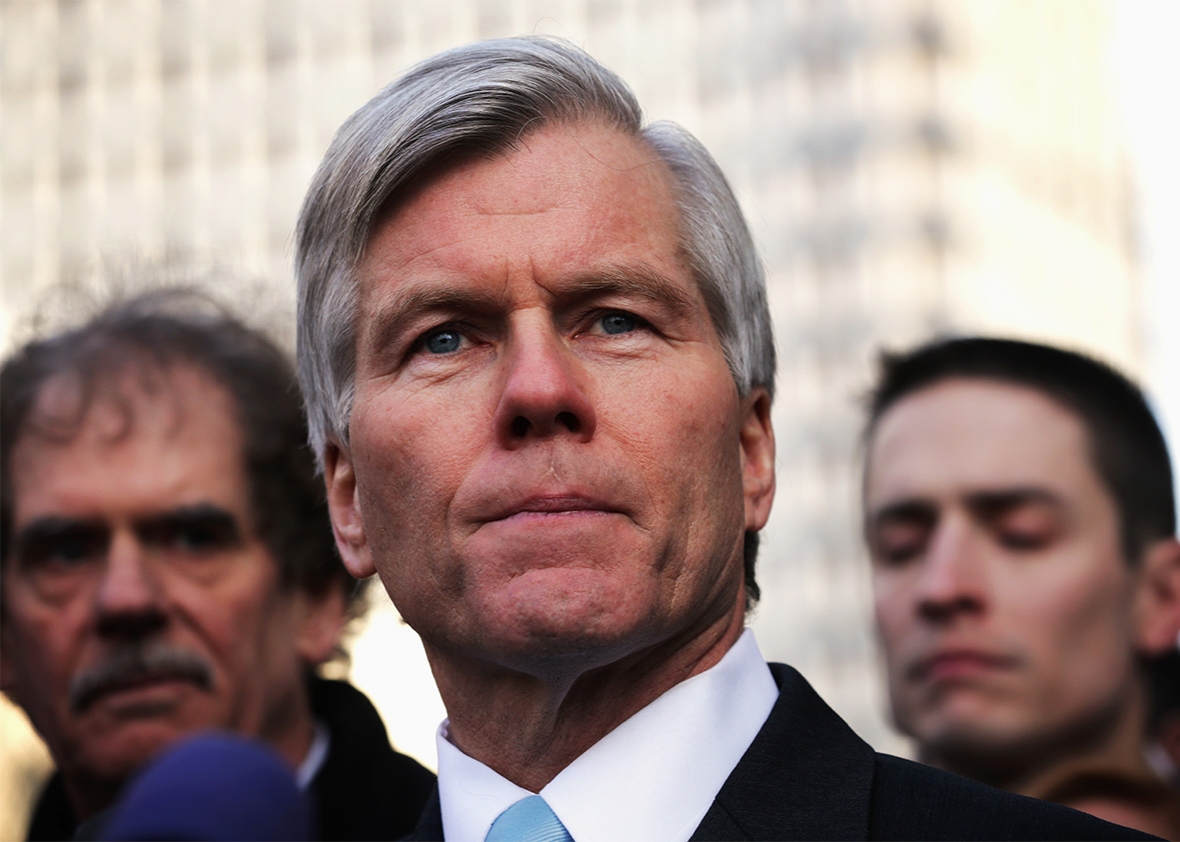
The U.S. Department of Justice (DOJ) has dropped its criminal case against former Virginia Governor Bob McDonnell, after the U.S. Supreme Court earlier this year overturned his convictions on public corruption charges.

That means McDonnell, who (along with his wife) received more than $175,000 in loans and gifts from a supporter, is a free man -- while former Alabama Governor Don Siegelman, who records show did not receive a penny in a similar case -- remains housed at a federal prison in Oakdale, Louisiana.

What are the differences in the two cases? There aren't many; the most important one might be this -- McDonnell is a Republican, and Siegelman is a Democrat.

In legal terms, the major difference involves context -- Siegelman took a campaign donation that the government claimed was a bribe, while McDonnell took . . . well, bribes that the government claimed were bribes. The Supreme Court has decided that's OK, while it has refused several times to even hear the Siegelman case. Here is how we explained such nonsense in a previous post:

America's federal bribery laws are a confusing mishmash, covered under several different statutes, written in language that is largely unintelligible. In fact, the statutes are so confusing that courts often turn to case law to determine what is, and is not, illegal.

The Siegelman case, for example, largely was governed by McCormick v. United States, 500 U.S. 257 (1991). He and (Richard) Scrushy were prosecuted under 18 U.S. Code 666, which is known as the "federal funds bribery" statute and generally applies to cases involving campaign contributions. (Scrushy's donation to help pay down debt for the Alabama Democratic Party, after Siegelman's lottery proposal had been defeated, was considered a campaign contribution.)

McDonnell, however, was prosecuted under 18 U.S. Code 201, a general bribery statute that usually does not involve campaign contributions. On the case-law side, McDonnell invoked Evans v. United States, 504 U.S. 255 (1992), which tends to involve bribery outside the context of a campaign contribution.

The bottom line: In Siegelman, Scrushy gave a campaign contribution. In McDonnell, constituent Jonny Williams showered McDonnell and his wife with gifts, which went directly to them, but he apparently did not make a campaign contribution. That means the two cases are covered by different law -- Siegelman is covered by the 666 statute and the McCormick case; McDonnell is covered by the 201 statute and the Evans case.

Who are the losers in all of this? Obviously, Don Siegelman is on the losing side. I would submit that the U.S. Supreme Court is a loser. Along with Bush v. Gore in 2000, McDonnell gives Americans an additional reason not to trust their high court.

The biggest losers, however, are the American people. The South has produced numerous substantive Democrats over the years, and our country needs those voices to be heard. But will they, and their financial supporters, go into hiding in the wake of what happened to Don Siegelman and Richard Scrushy? Has that process already started?

Karl Rove, and others who engineered the Siegelman prosecution, don't mind a few black Democrats who represent heavily black Congressional districts. But they are terrified of a white Democrat who might succeed on a statewide level, become a national star, and present a challenge to the GOP's stranglehold on the South. Don Siegelman fit that description perfectly, and that's probably the No. 1 reason he had to be stopped. Robert McDonnell, while from a Southern state, is a Republican and did not fit that description. That's probably the No. 1 reason he is a free man.

What does that mean for our country? It's not good, even if you are a Republican. We need two healthy parties who can govern, and the GOP already appears to be in free fall with the rise of Donald Trump.

When is the last time you heard of a really promising white Democrat from the South? Perhaps that is why Bernie Sanders, well into his 70s and from Vermont, was Hillary Clinton's only serious challenger in the 2016 primaries? After all, the Siegelman case sends this message: "If you are a white Democrat in the South -- or a financial supporter of a white Democrat in the South -- you risk personal destruction. Even a Democratic president, like Barack Obama, won't lift a finger to free you. And even a DOJ under a Democratic president will do nothing to investigate and prosecute those who wrongfully sent you to prison."

Democrats might feel secure in thinking that Hillary Clinton will win the White House this year. But who will come after her? It probably won't be a Democrat from the South because their numbers likely will keep dwindling.

That could be the "legacy" of the Siegelman case, and Barack Obama helped cut his party's throat in a region where presidential races often are won or lost.

Thursday, September 8, 2016

My brother, Missouri lawyer David Shuler, apparently knew cops were going to evict my wife and me with high-powered weaponry--and he let it happen anyway


Missouri attorney David Shuler
Have you ever had an assault rifle pointed at your head? I have, and please take it from me, it's an unsettling experience. In my situation, I had an assault rifle pointed right between my eyes, with five or six other law-enforcement types drawing and waving pistols in various directions.

It happened when my wife, Carol, and I were evicted from our apartment in Springfield, Missouri, almost exactly one year ago, on September 9, 2015. Evidence suggests that my brother, Missouri lawyer David Shuler, is at least partly responsible for allowing the unlawful eviction to take place. If I had made one wrong move and got my head blown off -- and Carol easily could have been shot, too -- well, I guess Missouri lawyers aren't supposed to concern themselves with such things, even when they know they are about to happen and the possible victims are family members.

What did David Shuler know, and when did he know it? Well, let's consider an e-mail he wrote to me on September 2, 2015, exactly one week before we were evicted. Right off the bat, he says I had asked him to stay out of our business, and I had threatened to sue him. I don't recall asking him to stay out of our business, although I might have noted that in instances where he supposedly was trying to help us, things did not turn out so well. I also don't recall threatening to sue him, although I think I made a reference in a legal document that, according to his own e-mail, he had contacted our landlord in a way that could be construed as tortious interference.

The e-mail centers around some bizarre claims by a deputy named Scott Harrison, who apparently placed a notice to vacate on the door of our apartment, owned by landlord Trent Cowherd. (By the way, this suggests Harrison had experience working eviction cases, so he should have known the relevant law. He should have known that the filing of a notice of appeal, which we filed within the lawful 10-day window and paid the required fees, puts a stay on execution of an eviction. But Harrison burst through our door -- I'm pretty sure he was the one pointing the assault rifle at me -- even though every attorney in the matter [including David Shuler] had been notified of the notice of appeal and stay. Sounds to me like Dep. Harrison and his band of thugs were instructed to ignore the law on this one. I wonder why?)

But let's examine the more important issue: Numerous readers and friends have asked me, "Why did the Missouri cops enter your apartment like a SWAT team, and with an attitude that led to Carol's arm being broken?" David's e-mail, I think, helps explain that. Here it is:

Roger: Per your request and your threat to sue me, I am doing my best to stay out of your business. As a good faith effort to stay out of your business, I would appreciate it if you would not respond to this e-mail. A deputy called me today and asked me to have you contact him. He said he posted the notice to vacate on the Cowherd property. He also said he was concerned because his dispatch contacted him and said you had called 911 and threatened to shoot anyone coming on the premises to get you out. I certainly hope that you did not really do that, but he asked me to make you aware that they take such threats seriously and that you are setting up a potentially dangerous situation. He stressed to me that he would like to help you find housing and that he did not want you or anyone else to get hurt. His name is deputy Harrison and his phone number is 501-6092. He is very concerned and stressed to me that he did not wish for you or anyone else to get hurt.

Let's note a few oddities about this e-mail, at least to me:

(1) David does not want me to respond to an e-mail in which he makes, or at least informs me of, an outlandish allegation against me?

(2) Why would a deputy contact him about an eviction involving Carol and me? David, on the surface, was involved only because landlord Trent Cowherd had sued our mother, with zero grounds for doing so?

(3) Is it normal for a deputy to post an eviction notice on an apartment door? I thought the landlord, or his staff, usually did that.

(4) Is it normal for a sheriff's deputy to help someone find housing? Unless, of course, that housing is the Greene County Jail. (No thanks on that one, bud; I think I'll find my own housing.)

(4) Neither David, nor Deputy (Scott) Harrison, seems to have the slightest idea that a tenant has 10 days to file a notice of appeal regarding an eviction order. Carol and I, of course, did just that, and by law, it put an automatic stay on the eviction. In other words, there was no "dangerous situation," other than the one caused by the determination of Sheriff Jim Arnott and Co. to ignore our notice of appeal -- of which every lawyer involved, including David Shuler, received notice.

(5) It's ironic to hear that Deputy Harrison did not want me to get hurt, but it appears he was the officer who burst through the door, with an assault rifle pointed at my head. If one of the other officers had jostled Harrison as he barged through our door, causing him to pull the trigger . . . well, I guess that would have sprayed my brain matter all over the place. But it's nice to know Deputy Harrison was concerned about my safety.

Missouri sheriff Jim Arnott
Given the untrue cow feces in David's e-mail, I was not about to let that go without responding. So here is my reply, sent on September 2. It references a blatantly prejudicial letter he had written to the judge prior to our eviction case, and I feel certain he didn't think I knew about that. It also references some legal sleight of hand the landlord's law firm, Lowther and Johnson, pulled to make sure we could not prove landlord Trent Cowherd was trying to violate our lease:

David: 
Would you please ask Deputy Harrison to procure a copy of any 911 call that allegedly was from me. My understanding is that such calls automatically are recorded. I also would like for Deputy Harrison to provide the name of any dispatcher who gave him the information you describe. Maybe Deputy Harrison can cite any law that allows for an eviction when the tenant still has time to file an appeal.

On another brief note, are you going to allow this to move forward even though the "judgment" in question is void, by law, due to lack of service. As a lawyer, I assume you know that, but you seem to have no interest in doing anything about it. I assume you also know that Cowherd's lawsuit against our mother is 100 percent bogus, but you aren't going to do anything about that either. Did you ask them to sue her just so you would have an excuse to be involved? That's how it looks from here.

Your letter to the court said you would do anything possible to help Cowherd regain possession of their property. Does that include helping Cowherd and their law firm cheat? Does that include poisoning the judge's mindset with a flagrantly ex parte and unlawful communication. The judgment is void, and we have a lawful period of time to appeal it, but we've already received an eviction notice on our door.

I also find it interesting that the Lowther lawyer intentionally didn't have the woman I talked with show up, so the hearsay rule could be invoked, and I couldn't prove how they have violated our lease. Again, I guess you either were in on that or just sat there and let it happen. But your letter makes it clear what your intentions have been all along, and this is my third request for you to serve me with a copy (of the letter). If you were brave enough to write it, why aren't you brave enough to serve it, as required by law, on parties in the case? I shouldn't have to ask for a copy. This so-called judge (Kelly Halford Rose), by law, was disqualified from the case due to your letter, and that's another reason the judgment is void. Why don't you tell that to Deputy Harrison?

You obviously have some deep-seated hatred for me that apparently goes back years, and I guess this is your big opportunity to stab me in the back. How you developed into such a morally bankrupt individual is beyond me. But your credibility level with me at the moment is zero. And this is just the latest example of you taking blatantly false information and throwing it in my face.

But regardless of the vindictiveness you have towards me, and regardless of what disturbance in your soul has caused it, the judgment in question is void as a matter of law on multiple grounds, and we have a right to appeal it, so I would suggest that you instruct Deputy Harrison to chill out and abide by the law.

Did David ever provide any of the information I requested about the alleged threatening phone call I made? Nope. Did David have any answers to his flagrantly improper, and vicious, letter to the judge? Nope. Did David ever serve me with a copy of said letter? Nope, although I have a copy of it, and we will be taking a look at it in an upcoming post? Did David advise Deputy Harrison to chill out and abide by the law? Given Harrison's behavior with an assault weapon, it sure doesn't look like it.

Here is the key point: I never made a call to 911, threatening or otherwise, but multiple deputies on the scene referenced such a call as grounds for their SWAT-team tactics. Here is another response I sent to David:

One other point: Missouri law says that in a rent-possession case, a tenant can pay the allegedly owed rent and fees and the case is over. My understanding is that we still have time to do that, but I guess you are going to allow a SWAT team to come in and shoot us before we even have a chance to pay. Did you completely check your conscience at the door when you entered law school, or was your conscience warped to begin with?

Even if we had paid the rent -- and we hadn't paid it because the landlord told us not to; we were going to be evicted anyway, on grounds not in the lease -- I guess I still was looking at possibly getting my head blown off. Here is one other thought I had for a brother I once thought was a great guy -- but who now appears bereft of any ethics whatsoever:

Making a false report to 911 . . . isn't that a crime? I can tell you for sure I did not place such a call. Therefore, I suggest you and Deputy Harrison initiate a criminal investigation to identify and prosecute the caller. Please let me know how the investigation is going, and I would be glad to assist in any way that I can. If such a call was made and my name was falsely used, I would like to see the person responsible behind bars. In fact, it sounds like I might need to file a police report. And if the cops won't take it seriously I probably need to contact news outlets.

After deputies had broken Carol's arm and were taking her to jail for allegedly "assaulting a police officer" (per Sheriff Arnott's instructions) a deputy Carol believed to be Harrison told her he had heard the 911 tape, that it was traced to our phone and to our apartment, and he was convinced it was me.

Well, it wasn't me, and it could not have been made by anyone at our residence, or from our phone. That means someone pulled off a fraudulent 911 call -- or the whole thing is a creation of Harrison's imagination.

You can bet that will be a subject for future inquiry.

Wednesday, September 7, 2016

Alabama cop Eric Parker, who badly injured man from India, is set to return to force -- and that should help fuel outrage behind Colin Kaepernick protest


Officer Eric Parker
(From whnt.com)
Less than two weeks ago, we completed a six-part series about the role judicial corruption played in the dismissal of criminal charges against an Alabama police officer whose brutal take-down left a grandfather from India partially paralyzed. Yesterday we learned the officer, Eric Parker, is returning from administrative leave and is set to rejoin the force in the Huntsville suburb of Madison.

Does a rogue judiciary have repercussions? It sure does. In this instance, it makes Alabama look like a slimy backwater -- the kind of place where a cop can use a leg sweep on a man with dark skin, whose "crime" apparently was walking down the sidewalk while not bothering a soul, and get away with it. Where two juries can deadlock along race and gender lines. leading U.S. District Judge Madeline Haikala to conclude that protecting Sureshbhai Patel's civil rights, and holding Officer Parker criminally accountable, was not worth the trouble.

Gee, and some people wonder why San Francisco 49ers quarterback Colin Kaepernick might feel the need to take a stand against the kind of police brutality that has become a front-page staple over the past two years or so? With Parker returning to the force, and Patel's roots in India making this an international embarrassment for the United States, far more people -- not just NFL football players -- should be joining Kaepernick in protest.

In a final insult to the public, acting Madison police chief Jim Cooke cited Haikala's 92-page opinion as grounds for finding that Parker did not violate departmental policy. If you actually read Haikala's ruling and educate yourself about the relevant law -- and Cooke obviously did neither -- here's part of what you find:

(1) A recent study found that 97 percent of police officers in violence cases never face criminal charges -- and it's little wonder given Haikala's butchery of the Parker case;

(2) For the few cops who do face charges, judges like Haikala are likely to cut them favors;

(3) Haikala threw out the charges against Parker based on a case that does not come close to supporting her finding. That's the kind of thing judges get away with when the public isn't paying attention;

(4) Documents show that Parker lied about three key issues in the Patel case -- and still Haikala threw out the charges;

(5) A third jury would have had ample grounds to find Parker guilty;

(6) Alabama surely is a more enlightened place than it was 50 years ago, but it's hard to tell that from the Parker case. It makes the state smell of judicial corruption, juror racism, and flaming injustice for which "Bull" Connor once stood.

Of course, those characteristics hardly are limited to Alabama. Perhaps that's why a second-string quarterback in San Francisco felt the need to do something, even if certain "patriots" took offense at his decision not to stand for the national anthem.

Colin Kaepernick
(From theguardian,com)
For those who are paying attention, Colin Kaepernick has taught an invaluable lesson. He has shown that concerns about law enforcement should go way beyond issues of brutality. My wife and I both have been the targets of rogue cops in the past 2-3 years, so we have some first-hand experience with these issues.

Once cops have committed violence against a citizen, they tend to immediately go into cover-up mode. This usually takes the form of piling one lie on top of another. We've seen cops do it in Birmingham, Alabama, and Springfield, Missouri. Court records show that Eric Parker did it in Huntsville, Alabama. And now, we have the police union in Santa Clara, California, sending a letter stating that cops are threatening to bail out on their security positions at 49ers football games unless the team takes action to silence Kaepernick.

How many of these cops have stood up to admit that a frightening number of citizens have been the victims of unjustified police violence? I don't recall any officers showing such courage. How many cops spoke out and admitted that Eric Parker's actions against Sureshbhai Patel, caught on video, violated general police policy and likely constituted criminal behavior? The silence has been overwhelming. (See video at the end of this post.)

Eric Parker's return to police duty should help create a groundswell of outrage against a tin-eared police community that . . . well, has just been asking for major blow back. With the kind of arrogance cops have shown, no one should be surprised that assassins in Dallas and Baton Rouge took matters into their own hands.

I would love to be president of the San Francisco 49ers right now. I would tell the police union to take their letter and jam it up their asses, and I would tell them they do not need to bother resigning from their paid, on-the-side security jobs. They are fired, and they should not let the door -- the one with the 49ers insignia on it -- hit them on the butt on their way out.

Why is the Eric Parker case so disturbing? It's not just about rogue cops or corrupt judges; it's about both -- and it shows that our "justice system" is rotten at every level. Its members do a fine job of protecting each other, but they sure do not protect the public.


Tuesday, September 6, 2016

Under Alabama law, Jessica Garrison's $3.5-million default judgment violates due process and any sense of "fair play" -- and I have unlimited time to attack it


Jessica Medeiros Garrison
Was it smart of GOP operative Jessica Medeiros Garrison to crow to the Marie Claire fashion magazine about her $3.5-million default judgment in a defamation case against yours truly? I would say no, especially given the ruling represents a classic violation of due-process rights, where I was deprived of the "fair play" that is supposed to be present in American courts.

The Marie Claire article last fall is particularly nonsensical when you consider that Garrison is a lawyer. She should have known that Judge Don Blankenship's ruling was contrary to Alabama law that frowns on default judgments, in part because they tend to short-circuit due process. Garrison should have known that, as we've shown in recent posts, she failed to give proper notice of her default application, making Blankenship's order void. She should have known that gives me unlimited time to attack the order as a nullity.

Even the antiquated Alabama Constitution of 1901 shows Garrison's default judgment was on shaky ground from the outset. This is from Kirtland v. Fort Morgan Authority Sewer Service, 524 So. 2d 600 (Ala. Sup. Ct., 1988):

Article 1, §§ 6 and 13, Alabama Constitution of 1901, by guaranteeing the due process rights of citizens, and Article 1, § 10, by holding inviolate a person's right to defend himself in a civil action to which he is a party, elucidates this state's commitment to protect an individual's right to attain an adjudication on the merits and to afford litigants an opportunity to defend. We, therefore, emphatically hold that a trial court, in determining whether to grant or to deny a motion to set aside a default judgment, should exercise its broad discretionary powers with liberality and should balance the equities of the case with a strong bias toward allowing the defendant to have his day in court.

In other words, I was supposed to have my "day in court," but Blankenship unlawfully trampled my right to defend myself. It's a sad day when the unwieldy, racist Alabama Constitution of yesteryear shows more respect for due process than does a black Democratic judge like Blankenship.

Jessica Garrison, to no one's surprise, is excited about a court acting corruptly in her favor? That speaks volumes about her "ethics." It also shows she has a massive sense of entitlement, a condition that seems to run rampant through the Republican population.

As for Garrison's judgment being void, a case styled Cornelius v. Browning, (AL Sup. Ct., 2011) helps drive home that point. (See also Abernathy v. Green Tree Servicing, Ala. Civ. App., 2010.) The Cornelius case revolved around plaintiffs who received a default judgment on several investment-related claims against a Blountsville man named Jeff Cornelius, among others. Cornelius claimed he had never received notice of the default motion. The trial court refused to overturn the default, but the Alabama Supreme Court took a different view:

On March 11, 2010, the plaintiffs initiated a garnishment proceeding in an attempt to collect the judgment against Cornelius. . . . On March 23, 2010, Cornelius moved the trial court to set aside its October 28 judgment and the subsequent garnishment proceeding. . . . Cornelius argued in his motion that he did not receive a copy of the plaintiffs' default-judgment motion and that allowing the default judgment to stand would be “a miscarriage of justice” and would violate principles of due process.

The state's high court agreed with Cornelius. From the ruling:

[w]hen the grant or denial of relief [from a default judgment] turns on the validity of the judgment, as under Rule 60(b)(4)[, Ala. R. Civ. P.], discretion has no place. If the judgment is valid, it must stand; if it is void, it must be set aside. A judgment is void only if the court rendering it lacked jurisdiction of the subject matter or of the parties, or if it acted in a manner inconsistent with due process. . . .

Procedural due process, as guaranteed by the Fourteenth Amendment to the United States Constitution and Article I, § 6, of the Alabama Constitution of 1901, broadly speaking, contemplates the rudimentary requirements of fair play, which include a fair and open hearing before a legally constituted court or other authority, with notice and the opportunity to present evidence and argument, representation by counsel, if desired, and information as to the claims of the opposing party, with reasonable opportunity to controvert them. It is generally understood that an opportunity for a hearing before a competent and impartial tribunal upon proper notice is one of the essential elements of due process. (citations omitted).

On paper, at least, Alabama courts take due process and fair play seriously. How seriously? Consider this from a case styled McConico v. Patterson (Ala. Court of Civil Appeals 2016). It addresses post-judgment motions, which normally are subject to time constraints. That is not the case when the motion seeks to overturn a void default judgment:

[A]s a nullity, a void judgment has no effect and is subject to attack at any time. . . . [A] motion for relief from a void judgment is not governed by the reasonable-time requirement of Rule 60(b)[, Ala. R. Civ. P.].

A case styled Ex parte Full Circle Distribution, L.L.C., 883 So. 2d 638, 643 (Ala. 2003). helps drive home the point:

The rationale for being able to vacate a void judgment at any time is that "a void court order is a complete nullity." Hodges v. Archer, 286 Ala. 457, 459, 241 So.2d 324, 326 (1970). As a nullity, a void judgment has no effect and is subject to attack at any time.

Jessica Garrison is the lawyer here, not me, so you might expert her to know the judgment is a "nullity" which "has no effect." You might also expect her to know about this law regarding fair play. I can only conclude that Garrison isn't interested in fair play -- and she probably made sure I had no notice, and could not appear, because she didn't want anyone to controvert her story in court. As I've noted before, an attorney who reviewed the file -- I haven't seen it since being forced to leave Alabama -- said the record showed that notice of the default application and hearing was not sent, much less received.

On a final note, consider Garrison's attorney, the "estimable" (maybe that should be "excremental") Bill Baxley. Just yesterday, Alabama Political Reporter editor Bill Britt published a piece that portrayed Baxley as an utter doofus in the courtroom during post-trial hearings in the Mike Hubbard case. But Baxley has been a courtroom clod-head long before the Hubbard case came along. In representing Garrison, he allowed a corrupt judge to issue an order that was void before the ink had dried on paper, and then foolishly let his client crow about the order to an international audience, ignoring this inconvenient truth -- the order is a nullity that has no effect; it's worth equals zero, not $3.5 million.

If Garrison isn't interested in fair play, what does "float her boat"? She seems to be interested in getting something for nothing, whether she deserves it or not. That brings us back to entitlement, and she seems to have a massive sense for that.

Perhaps Garrison knew, from the get-go, that she did not have a legitimate defamation claim, but she had the "connections" to make sure she got a favorable outcome anyway. That's how shallow, morally bereft individuals view our court system -- as a plaything to pull con games on the rest of us.

Friday, September 2, 2016

Tuscaloosa attorney John Fisher Jr., already facing methamphetamine-trafficking charges, is arrested on new, unrelated charge of receiving stolen property


John Fisher Jr.
A Tuscaloosa attorney who recently was arrested on meth-trafficking charges has been arrested again. This time, John Fisher Jr. faces a felony charge of receiving stolen property, according to a report today from The Tuscaloosa News.

Fisher turned himself in at noon today at the Tuscaloosa County Jail and was released within the hour. The new charge apparently is unrelated to the meth-trafficking charges, which came about two weeks ago. From an article by reporter Stephanie Taylor:

Tuscaloosa attorney John Fisher is accused of being in possession of a stolen Harley Davidson motorcycle.

Fisher, 48, turned himself in at the Tuscaloosa County Jail at noon Friday and was released within the hour. The arrest comes two weeks after he was charged with meth trafficking.

Investigators say that Fisher was in possession of a 2000 Harley Davidson motorcycle worth $5,000 that had been stolen from a victim in Fayette County on April 12, 2013.

The suspect in the case sold the motorcycle in August, said Tuscaloosa Police spokeswoman Lt. Teena Richardson.

It's been an interesting couple of weeks for Fisher. Reports Taylor:

Agents in Tuscaloosa who were investigating Fisher on the meth charge obtained a warrant to charge him with receiving stolen property, she said. Fisher was arrested Friday and later released on $30,000 bond.

Fisher was first arrested Aug. 19, after a bail bondsman called West Alabama Narcotics Task Force officers to report that a man named Christopher Shane Rushing had left a suspicious bag at his office.

The bondsman suspected that the bag contained a meth lab, and suspected that he was being set up to be arrested, according to court documents. The ensuing investigation led to Fisher and Rushing's arrest on meth trafficking charges.

Firefighters were called to the bonding company early Sunday morning after a suspicious fire was set at the rear of the bondsman's office. Results of the investigation haven't yet been released.

Thursday, September 1, 2016

Missouri deputy who shattered my wife's arm violated policy on use of force, and his department has not conducted investigation according to its own policies


The Missouri sheriff's deputy who broke my wife's arm during an unlawful eviction last September violated departmental policy on use of force. Also, the Greene County Sheriff's Office has failed to follow its own procedures for investigating such incidents.

Is that a sign an attempted cover-up is under way? As a witness, who is married to the victim, that's how it looks from here.

How do we know the officer involved, whose name remains unknown to us (although we now can make a pretty educated guess at his identity), violated policy? The Greene County Sheriff's Office Policies and Procedures Manual is online -- and it makes clear how such incidents should be handled. Let's just say quite a gap exists between words in the manual and the reality of how my wife, Carol, was treated -- both before and after her arm was snapped in two, just above the elbow.

The manual spells out how such "critical incidents" are to be investigated. We know for sure certain elements of those procedures have not been followed -- and God only knows if any of the investigative procedures called for have been taken.

As for the brutality used against Carol, can any justification for it be found in Greene County policy? Absolutely not. Consider these words from page 60 of the manual, under "Subject Resistance and Control":

It is the policy of the Sheriff’s Office to provide its employees with proper training and guidance on the permissible use of force. This policy will ensure that the level of force used was reasonable, and required to subdue an individual offender or restore order to a disruptive group

That makes it clear an officer can use only a reasonable level of force required to "subdue an individual offender" or restore order to a "disruptive group."

Carol's "group" consisted of me (I was sitting in the driver's seat of our car) and our late kitty kat, Baxter (who was in a pet carrier on the hood of the car, where an officer had placed him, much to my chagrin). Neither Baxter nor I made a peep as Carol walked to the front door of our apartment in an effort to retrieve his litter box. Translation: She was not part of a "disruptive group."

As Carol approached the front steps, three officers surrounded her, and one slammed her, rear-end first, to the ground. She was thrown with such force, and came to such a sudden stop, that I believe she probably suffered a concussion. An officer then yanked on both of her arms -- in an upward and backward motion -- badly bruising both arms and breaking the left one so badly that it required trauma surgery and the implantation of numerous screws and titanium plates.

Carol had to undergo physical therapy several times a week for approximately four months -- with the best likely outcome that she will have 75-percent usage of her arm restored. (By the way, Missouri Medicaid covered Carol's surgery, but it does not cover the therapy, so that was on us, and we can't afford to pay it. Now, we are getting regular debt-collector calls, asking about the $7,500 apparently owed. Maybe we should refer them to the Greene County Sheriff's Department. It's nice to know that politicians in Missouri are just as stupid as the ones who have driven Alabama into the ditch. To have trauma surgery, without physical therapy, pretty much ensures the surgery will be a failure, and the patient likely will become permanently disabled for the rest of his or her life. To cover surgery, but not therapy . . . well, it's hard to imagine a more ignorant approach than that.)

What offense did Carol commit that required such a violent response? Let's see . . . she didn't resist arrest because no one said she was under arrest -- and she did nothing for which she could be arrested. (Does Missouri have a statute that prohibits the "unlawful retrieval of a kitty kat's litter box"? I haven't found such a statute.) Carol did engage in some verbal sparring with one of the officers, and I heard her say, "I'm only trying to . . ." -- and then I couldn't make out the rest, but I think that sentence ended with "get our cat's litter box." Did she threaten or curse anyone? She says she didn't, and I didn't hear anything like that.

Carol did not initiate physical contact with anyone, even though Greene County Sheriff Jim Arnott, who was standing about five feet away, immediately pointed at her and said, "She assaulted a police officer." She was handcuffed -- with her broken arm yanked behind her back -- and placed in the back of a squad car. The transporting deputy said she likely was looking at a $100,000 bond, which meant a felony charge.

X-ray of Carol Shuler's broken arm, before
repair via trauma surgeon.
Only when a woman at the jail paid attention to Carol's cries of help for her arm did it start to become clear that something was wrong. She was sent for X-rays to a nearby hospital, which revealed the severe break. Suddenly, it seems, sheriff's officials realized Carol was the victim of an assault, not the perpetrator of one -- and she still has not been charged with anything. Translation: Force, of a reasonable nature, can be used only to subdue an "individual offender." But the actions of Greene County officials show Carol committed no offense, so any amount of force used against her was unreasonable -- according to the sheriff department's own words.

As for investigation of the incident, consider these words from page 116 of the manual, which states that a criminal investigator will be appointed and . . .

Shall ensure interviews of witnesses, victims, Involved Deputy(s), and when applicable suspect(s), including providing Miranda warnings, even to the Involved Deputy. The investigator should attempt an interview as soon as possible with the Involved Deputy, but should take into account the Involved Deputy’s post incident demeanor and understand the investigator’s role is to obtain an accurate account of the event.

Carol was the victim, and I was a witness, and no one from the sheriff's department has interviewed us in almost 12 months' time. That means this step is incomplete, or has been skipped altogether.

What else is supposed to be done in the wake of a "critical incident," and has any of it been done in the brutality case against Carol?

We will look at that in an upcoming post.